- Hover the Mouse over Text, Links, and Pictures for more Details -
by Dennis & Terry Struck


 Bicycle Checklist
Bike Tour Checklist
Bicycle Touring Checklist
Bicycle Packing Checklist, v63bike touring, bicycle touring, bike tour, bicycle tour, bike touring checklist, bicycle touring checklist, bike tour checklist, bicycle tour checklist, gear checklist, bicycle gear list, bike tour gear list, all about bicycle touring, all about bicycle tours, about bicycle touring, all about bike touring, all about bike tours, about bike touring, cycling checklist, bike touring 101, bicycle touring 101, self contained bike touring, self contained bicycle touring, self contained bike tour, self contained bicycle tour, about bike bicycle cycle tour, touring checklist, bicycle journey bicycling, bike checklist, bike check list, velo bici bicicleta travel trip campaign expedition, bicycle survival tips and tricks, tour cycling holiday items cycle ride riding campain vacation campaigning supplies packing adventures adventure stories story saddle tale tales ultralight ultra light cycling camp checklist, Bicycle Equipment, Bicycle Tour Configurations, Bicycle Tour Issues, Bicycle Panniers, Bicycle Trailers, Bicycle First Aid Kit, Bicycle Tour Navigation, Bicycle tour Base Sustenance, On Bike Clothing, Bicycle Medicine, Bicycle Tour Hygiene, Bicycle Camping Checklist, Bicycle Tour Shelter, Bicycle Tour Cooking Supplies, Bicycle Tour Cooking Equipment, Bicycle Tour Base Foods, Off Bicycle Clothing, Bicycle Tour Toiletry, Bicycle Optional Tour Items Checklist, Bicycle Expedition Tour (30 + Days), bike packing, multiday packing, multiday bike packing, multi day bike packing, gear list, equipment list, bike gear list, bike equipment list, bicycle gear list, bicycle equipment list
Bicycle Touring Checklists - Table of Contents
#1 Google Return on "Bicycle Tour Checklist" - 1997 to 2008!
This page still remains popular because of the 'All About' Explanations
to be discovered when hovering the cursor over Topic(s).
OBJECTIVE:
Take the LEAST NEEDED Amount/Quantity/Volume that meets the
Situational Requirements.
Every trip has different needs
and everything listed isn't needed for every trip.

- Dan Buettner, On Cycle Touring, also biked across Africa
 Bicycling Checklist
Bike Touring Checklist
Bicycle Touring Checklist
Bicycle Traveling Checklist
(Without Camping)bike touring, bicycle touring, bike tour, bicycle tour, bike touring checklist, bicycle touring checklist, bike tour checklist, bike tools checklist, bicycle tool checklist, bicycle toolkit checklist, bicycle toolkit checklist, toolkit list, bike toolkit list, bicycle toolkit list, bicycle tool kit checklist, tool kit list, bike tool kit list, bicycle tool kit list, bicycle tools checklist, all about bicycle touring, all about bicycle tours, about bicycle touring, all about bike touring, all about bike tours, about bike touring, bicycle tour checklist, bike touring 101, bicycle touring 101, self contained bike touring, self contained bicycle touring, self contained bike tour, self contained bicycle tour, fully loaded bike touring, fully loaded bicycle touring, fully loaded bike tour, fully loaded bicycle tour, Bike Touring Checklist, Full Load, Fully Loaded, Bike Checklist, Long Bicycle Tour Checklist, Long Touring Checklist, Bicycling, Cycle Touring, Expedition Bicycle Checklist, Bike Tour Gear List, Bike Checklist, Bike Packing Checklist, , Bike Ride, Bike Riding, Bicycle Ride, Bicycle Riding, Bicycle campain, campaign bicycle journey, Bicycle Campaign, Bicycle Campaigning, Bike Travel, Self Supporting Touring, Self Supported Bike Tour, Self Contained Tour, Bicycle Tool Checklist, Cycling Holiday Checklist, Cycle Touring, Bicycle Tour Packing Checklist, What to Pack for Bike Touring, Cycling Holiday Checklist, Check List of Touring Items, Checklist of Touring Items, Cycle Touring, bicycle tour tools, about bike bicycle cycle tour touring checklist bicycle camping cycling, fully loaded full load bicycle journey bicycling bike checklist, check list velo bici bicicleta travel trip campaign expedition pannier panniers trailer carry bag case ship shipping packing commercial, airlines airline express suitcase luggage transporting survival tips and tricks tour cycling holiday items cycle ride riding campain vacation campaigning self contained supporting supported tool tools holiday, supplies packing adventures adventure stories story saddle tale tales, ultralight ultra light cycling camp checklist transportation, transport images pictures graphics chain oil bicycle tour tools, About Stealth Camping, about wild camping, wild camp, wild camp precautions, About Bicycle Touring Bicycle Survival Tips and Tricks, Getting Started, Planning Metrics, Planning Traps, travel log, travelogue, Road Rules and Positive Behaviors, Crash Survival, Body Conditioning, Group Cycling, Signals, Crash Avoidance, Tandem Bicycle Touring, Cycling Clubs, Cycling History, Bicycle Touring Checklists, Bicycle Equipment, Bicycle Tour Configurations, Bicycle Tour Issues, Bicycle Panniers, Bicycle Trailers, Bicycle First Aid Kit, Bicycle Tour Navigation, Bicycle tour Base Sustenance, Bicycle Tools, Bicycle Materials, On Bike Clothing, Bicycle Medicine, Bicycle Tour Hygiene, Bicycle Camping Checklist, Bicycle Tour Shelter, Bicycle Tour Cooking Supplies, Bicycle Tour Cooking Equipment, Bicycle Tour Base Foods, Off Bicycle Clothing, Bicycle Tour Toiletry, Bicycle Optional Tour Items Checklist, Bicycle Ultralight Camping Checklist, Bicycle Expedition Tour (30 + Days), How Much to Pack on a Bicycle Tour, Long Term Bicycle Travel Issues, International Bicycle Travel Issues, bicycle Tool Kit Checklist, 20+ Common Mechanical Issues, 20+ Common Mechanical Solutions, bike tool checklist, bicycle camping gear list
Top
Bicycle Camping Checklist - The Next Checklist
Following is a Bicycle Touring Checklist which contains a list or checklist (check list) of items to bring on a bicycle tour and this page contains information All About Bicycle Touring. Some of these bicycle touring checklist recommendations are based on a rider or group being miles away from a telephone, cell, or town, and days away from replacement parts. Most of these recommendations come from our own experiences but some recommendations come from other people (told in person, email, or read about; appreciated and cited appropriately). Everything listed is not needed for every tour.
OBJECTIVE:
Take the LEAST NEEDED Amount/Quantity/Volume that meets the
Situational Requirements.
Every trip has different needs
and everything listed isn't needed for every trip.
Top[ ] Bicycle(s) (Test Ride; Bicycle in Safe Working Condition, Prior Tune-up with Shake-Down Ride & Fine Adjustments) Bicycle Safety: Daily Safety Check to include: [ ] Tire Inflation Pressure [ ] Lighting, Visibility [ ] Brakes and Shift/Drivetrain System Equipment (Overview About Touring Configurations, Select Equipment based on Cyclist's Touring Needs) [ ] Pannier Racks, Rear and Front Caution, All About Racks, Quick Notes, About Threadlock Compound. [ ] Skewer(s) of Approriate Width and Configuration [ ] Panniers, with secure mounts, loose ends secured, well fitted racks (front and back), pre-eliminate noise. Quick Comments About Panniers [ ] Trailer, with mount system and all parts in operable condition. More About Trailers Trailer Splash Shield Suggestion [ ] Handlebar Bag with Map Case Cover or separate Map Case Cover, Notes, More Notes, carry strap for detachable bags.
[ ] Brake Lever Strap, Problem / Solutions-Caveats [ ] Backpack (Optional, usually for Ultralight Packing but occasionally just for water/hydration pack combo) Ultralight Pack About Ultralight Cycling Checklist [ ] Bottle Cages and Water Bottles (Full), About, Water Issues [ ] Wheels, Rims, and Spoke Integrity, Issues [ ] Pedals, appropriate (condition; mtn, road, tour; clipless, cleat, clip, strap, power grip; quick release; and Shoe fit/condition) [ ] Bar Ends or Multi-Position Handlebar. Issues, Bar Ends, Protect the Integrated Brake/Shifter. Also, consider reading our Notes on How to Survive a Crash/Fall. Optional Equipment (also see Additional Gear/Equipment): [ ] Seat Post Mini Bag (Wheel Repair Kit & Bike Tools) - (Optional: Tool kit may be carried in Ultralight bag, pannier, or trailer). [ ] Stoker Bag (for Tandems, Optional), Mapcase [ ] Top of Rack Bag(s), Frame Bag (Optional) [ ] Fenders (Optional: Pros Cons Caveats) [ ] Kick-Stand (Optional: Pros, Cons1, Cons2) [ ] Inclinometer (Optional - Not used by us) Travel Supplies [ ] Waterproof Carry Bag(s) / Stuff Sacks, Best: See-Through Waterproof Bag(s, like Kayak clear plastic Gear Storage Bags) [ ] Extra Ties, Velcro Straps, Bungee Cords, Bungee Net [ ] Bike Cover: Optional Hints [ ] Seat Cover: Optional Multiple Issues Chaffing Hint from Wayne E, from Down Under Safety: [ ] Helmet (Always Wear) [ ] Bike Gloves / Winter Gloves / Spare Gloves as appropriate Comments (Always Wear) [ ] Mirror (helmet, bike, handlebar, bar end, eye glass) [ ] Bell / Horn, Notes [ ] Sunglasses, FlipUp, ClipOn, Eye Glass Covers eye glass / sun glass holder-protector. Things get quite shaken and rough handled during bike tours. [ ] Bicycle Chain/Cable and Lock. Issues [ ] Pant Cuff Straps, Reflective! Cool Notes [ ] Visibility Markers [ ] Night Light System - Check, Test. Spare Batteries, bulbs/diodes, charger if needed, appropriate electrical connecter, About Night Lighting, More Anti-Theft and Theft Recovery Actions (About Bike Theft, Making Your Bike Look Unattractive - anti-theft measures): [ ] Identification Markings or ID Tags on Bicycle. [ ] Mark ID on Equipment (panniers, bags, major clothing, major gear) [ ] Have good digital Photographs of your Bicycle <<< VERY IMPORTANT <<< (store images in travel and home computer/notebook, camera, phone, and have them available online at a 'back home' web page). Do have Good Photographs, for example: 1. Slick/Clean bicycle image like it came from the factory 2. As it is with no panniers but with current accruements (tool kit, pedals, pump, computer, lights, ...) 3. As it looks for fully loaded touring [ ] Register Ownership [Where, it is often required in big cities, Usually with the manufacturer, but also with an International Bike Registry like at http://www.mybikenumber.com/, it's free.] [ ] Smart Phone and Computer Issues: 1. Use/set ID and PWD for travel 2. There are some system hidden applications that allow a registered user to remotely shut down their computer and smart phone (when the thief tries to connect to a network; some apps do more, for a cost)
Bicycle Touring First Aid Kit, Part 1 of 2First aid kit, firstaid kit, First aid kit Checklist,
Part 1 is a Crash Kit for Managing Road Rash and Pain - These recommendations come from Experience. - See Outdoor-Group First Aid Kit for a more comprehensive kit. - Keep/Make this kit immediately availabe (not buried deep) - Big Reminders for Impact Injuries - Maintain up-to-date First Aid and CPR ratings (yes, titles change) - See the Section on lessons about "How to Survive a Crash/Fall." [ ] 4x4 inch pads for cleaning/wiping wound and soaking blood (6-10x)
firstaid kit checklist, bike First aid kit, bike firstaid kit, bike First aid kit Checklist, bike firstaid kit checklist, Bicycle First aid kit, Bicycle firstaid kit, Bicycle First aid kit Checklist, Bicycle firstaid kit checklist, items for a first aid kit, what to pack in a bicycle first aid kit, bicycle tour First aid kit, bicycle tour firstaid kit, bicycle tour First aid kit Checklist, bicycle tour firstaid kit checklist,
bike tour First aid kit, bike tour firstaid kit, bike tour First aid kit Checklist, bike tour firstaid kit checklist, medicine for a bicycle tour, medicine for a bike tour, Bicycle Tour First Aid Kit Checklist, Bike Tour First Aid Kit Checklist[ ] 4x4 inch Non-Stick pads for covering wound (4-8x) [ ] 3 to 4 inch wide, long wrap/bandage (like Ace Stretch Wrap, 1-2x) Fastener Comments [ ] Saftey Pins, Large (4-8x) [ ] Bandage strips, self sticking, with 2 to 3 inch square pads, (4-6x) [ ] Gloves, Disposable (Latex, Vinyl or Nitrile), Comments [ ] Wound Sanitizer/Cleaner: Betadine, Hibiclens, Peroxide, Baby Wipes
or Soap [and Water],- in that order), 6-10x packets or 1 small bottle of 2-3 ounce volume - may make one's own small bottle solution (water bottle and soap) [ ] Antiseptic Spray, small can, usually anti-bacterial and anti-pain (learned from roadside incident - Gordon - great for minor road-rash/scrapes and non-touch applications) [ ] Baby wipes also work for cleaning abrasions (Also recommended as a regular touring item) [ ] Antibiotic Salve for dressing cuts and abrasions (1 small tube) [ ] Hydrocortisone (1 small tube, 1% or 2.5%, cream or ointment, ointment remains longer but is greasy, topical only,
reduces/supresses inflammation/rashes/saddle sores/allergic reactions). Notes [ ] Tylenol, Acetaminophen: for muscle and body pain, joint pain, headaches, fever, allergies, cough, cold, and flu - called Paracetamol outside of North America (10-20 Tablets/Capsules) [ ] Motrin or Advil, Ibuprofen: non-steroidal anti-inflammatory, pain killer - called: Nuprin, Medipren, Brufen, Other countries: Algofren, Dolormin, Eve (Japan), Herron Blue, Nurofen (10-20 Tablets/Capsules) [ ] Benadryl, Diphenhydramine Hydrochloride: General antihistamine, anti swelling, sleeping pill, sedative, anti-vomiting/nausea, motion sickness, called Dimedrol outside North America (5-10x Tablets/Capsules) [ ] Tape, 1 inch wide, surgical tape (3-6 yards or meters). Duct Tape works in emergency situations (but will tear skin upon removal). [ ] Print and keep a copy of this first aid kit checklist text in the
First Aid Kit. This list is especially helpful in other countries when a pharmacy (foreign medication name/word) purchase may be needed and helpful for re-checking inventory. [ ] Bandages 1/2 and 1 inch wide (1.5 cm & 2.5 cm wide), keep in tool kit, in small plastic bag (3-4x, each) [ ] Bandanna, Cravat (very utilitarian). Observation [ ] Medications, Other (Personal, Allergy, ...) [ ] REMINDER: The following items are mentioned elsewhere in this Bicycle Touring Checklist, but should be considered as Additional First Aid/Emergency Supplies: note pad, pen/pencil, matches, duct tape, flash light, knife (with tweezer
and scissors), soap and water, baby wipes, plastic zip bags, reflector triangle, chap stick, Gatorade Powder (electrolyte and re-hydration), and a communication device. [ ] Optional: Tampex Pads (and Tampons) are great trauma blood soakers [ ] Optional: Celox is the latest trauma (combat) blood plugger (online) [ ] Optional: Blanket Pins (order online)
Bicycle Touring First Aid Kit, Part 2 of 2
Part 2 is about Treating Tour/Travel Medical Ailments - In addition to items mentioned previously - Know everyone's allergies/reactions and adjust accordingly - See Outdoor-Group First Aid Kit for a more comprehensive kit. - We tend to carry these items separately from the crash kit, along with the Vitamins, Supplements, and less emergent items. Additional Medical Aids: [ ] Dressing / Gauze, Non Stick [ ] Swabs [ ] Moleskin & Molefoam
Medicines (small quantities, some are more optional, other health items are listed at Hygiene and Toiletry): [ ] Antihistamine / Allergy [ ] Anti-Diarrheal: Lopermide (May need Prescription) or Imodium AD (Over-the-Counter) [ ] Anti-Nausea: Phenergan (prescription), pill or suppository (in case one can't hold anything down) [ ] Anti-Acid: Mylanta / Maalox [ ] Anti-Fungus: Lotromin AF / Tinactin (Cream) [ ] Eye Drops: Visine, Antibiotic or Steroid (Rx) [ ] Moisturizing Lotion (Eucerine, really good stuff)
[ ] Vaseline (Petroleum Jelly) [ ] Sting / Itch Relief: Calamine [ ] Sun Burn: Solarcaine (Gel or Lotion) [ ] Prescription Antibiotics (like Cipro) and/or Rx/OTC Meds (like Malarone [Malaria], ...) for known outback area conditions (see World Health Org's Travel Advisory by Country). Hint: Consider not throwing away used packaging as keeping it may help one remember what is needed to be resupplied as well as serving as a hint to foreign pharmacists for resupply. Hint: Use 4x4 pads or trauma pads to soak blood - Avoid cotton balls, too stringy/messy in wounds.
Optional: [ ] Mini Scrub Bush (about size of big thumb) - Scrub Abrasions (else use 4x4 pads) [ ] Epinephrine (Adrenaline) Auto-Injector (aka EpiPen, Anapen and Twinject brands) - One must know when and how to use properly. When we give sag wagon and/or give volunteer support, we carry a larger Medical Kit presented at: Outdoor-Group First Aid Kit a more comprehensive kit.
Clothing (On Bike Cycling) Suggestion: See How much to Carry, Also See Off Bike Clothing[ ] Headband(s) - Good wicking, will keep sweat out of eyes, Sweat/Sunscreen Protection [ ] Balaclava (for colder days or brisk mountain/desert mornings) [ ] Shorts, either or both: Combination Short Pant with built in UnderLiner, <or> Separate Underliner(s) and Short(s). Issues, Warning [ ] Shirt(s) or Bike Shirt(s): Fast dry moisture wicking. Short and/or long sleeve. Long sleeve for much cooler weather or days/weeks of sun exposure. Issue [ ] Sleeves (optional) Issue [ ] Biking Tights: Warm and Fast Dry - waterproof rain pants may be a utilizable substitute [ ] Store in Waterproof Container (Nylon Dryseal, Rubberized Bags, Clear Plastic Waterproof Kayak Bag Best) [ ] Windbreaker [ ] Waterproof Rain Jacket(s), There are two varieties for two conditions: [ ] Hot to Cool conditions: Super light weight waterproof nylon rain jackets that have good vents, traditional long tail, back and front pockets and hopefully with reflective piping and zip away sleeves, [ ] Cool to Cold conditions: GoreTex type waterproof nylon rain jackets that have good vents, traditional long tail or square front and back, front pockets and hopefully with reflective piping/strips. Comment
[ ] Waterproof Pant(s) lightweight waterproof nylon and/or heavier GoreTex type. [ ] Waterproof Hat, in addition to helmet, but waterproof helmet covers do exist. Other Hats (baseball, sun with brim or neck shield, bug with net, cold) [ ] Chemical Warmer(s) Experience Footwear (may combine functionalities): Experience [ ] Boots or Heavy Duty Shoes for Mtn Bike Camp/Tours [ ] Running/Cross-Trainer type for Light Trips, waterproof. [ ] Shoe Cleat or Toe Clip Shoe System, Comment [ ] Shoe Cover (rubber/water-proof cover) Comment [ ] Bicycle Sandals Notes [ ] Stream Crossing Footwear, Comment [ ] Socks, Lots & Appropriate (synthetic moisture wicking) Sustenance, Cycling Only (Also see the Camping and Cycling Sustenance, or On/Off-Bicycle Tour without Cooking ): [ ] WATER!, Full Water Bottles or Containers, Keep Hydrated! (Water/Sanitation/Health Issues: Clean Water Risks, Filter/Purifier Issues, Sanitize Boiling, Water Management Routine, Water Collection Methods, Cold Weather Warnings/Habits) [ ] Road/Trail Food (while traveling, for ongoing Energy Supplement): Trail Mix, Nuts, Banana(s), Bread and Cheese, Jerky, Fruit (Fresh or Dehydrated), How to Tour Without Cooking [ ] Concentrated Energy Fuel, choice(s): Energy Powder (Packet or Canister), Energy Gel (Packet), Energy Bars, and/or Energy Liquid (last choice because of extra liquid/water weight to carry) Make Your Own Electrolyte [ ] Trash Bags (Pack it OUT!), Leave No Trace, Trail Philosophies Optional: Depending on type of tour, where and when; Required for Most Camping Tours: [ ] Water Bladder(s), About Water Bladders [ ] Water Filter/Purifier (for extended treks, Rinsed with Chemical Solution before trek), extra filters, chemical treatment (Clorine Dioxide, tablet or liquid, NO Iodine) Hygiene: Important; Also see Medicine and/or Toiletry. [ ] Toilet Paper, Baby Wipes (protect both, in zip lock plastic bag), Also be familiar with Trash Management [ ] Garden Spade, How to Poop in the Wild [ ] Feminine Hygiene Products [ ] Prescription (Rx) Medication, the Actual Paper Prescription; Sometimes Medicine Schedule(s), Bottles, Bags, Pill Box(es); Delivery Device: Dropper, Spoon, Cup, ... [ ] Vitamins/Supplements Personal/Handy (Often carried in/on Handlebar Bag):
[ ] Marking Pen (Magic Marker type, skinny, permanent, used a lot) [ ] Lip Balm with UV Protection (High SPF Rating, 30+) [ ] Sun Screen (High SPF Rating, 30+) [ ] Insect Repellent: DEET: Health Issue Equipment Destruction Issue Permethrin Proper Usage and Health Safety Issues - Requires prior wash or spray application, Other Repellent of Choice [ ] Glasses (Rx, cases, spares; Sun: clip-on, flip-up) [ ] Antifog material for glasses and mirrors, Note [ ] Pocket Knife. Notes [ ] Cord, Rope, Twine [ ] Money: Bills and Coins, Emergency Stash, Notes See Finance following [ ] Optional: Thermometer [ ] Optional: Personal Protection Device and/or Bear Spray [ ] Optional: Dog Spray Finance: [ ] Money, Country Denominations Hints [ ] Money, access to money, Prearranged Bank Stops Hints [ ] Document / Money Holder: Many choices like Neck, Waist, Leg; Hidden or Visibly Displayed (like a fanny pack) Warning [ ] Drivers License [ ] Insurance [ ] Credit Cards [ ] Checkbook (with desired check quantity) [ ] Travelers Cheques Navigation: (Also see Navigation Tips and/or Learn Sun Navigation Methods). [ ] Map(s) Map Sources, Caution [ ] Itinerary (Page-at-a-Glance and Detailed), Plans, Schedules, Timetables, Wish List (Places, Events, & Foods), Tickets, Vouchers, Travel Guide [ ] Passes, Licenses, Paid Receipts, Keys, Codes, Confirmation Names/Numbers [ ] Passport, Visas, Property Visitation Statements, Permission Slip(s), Reservations [ ] Photocopy of Passport & Itinerary (not to include the SSN) [ ] Bike Travel Calculator, aka Bike Computer, Spare Batteries Observation and Lesson [ ] Compass, GPS, Altimeter, Spare Batteries (Options: Clear Plastic Grid/Plotter/Scale, Marking Pen, Highlighter) [ ] Watch (Notes), Alarm (Avoid Hour Bleeping Watches), Multi-function, Learn About Sun Navigation, Some Watches Have GPS [ ] Word List, Language Translation Book/Dictionary, Translator Device
Bicycle Tour Tools Checklist
(aka: Bike Tool List, Bicycle Tool Kit Checklist,
Bike Toolkit Checklist,
Bicycle Tool Kit List, Bike Tool Kit List, Bike Tool Checklist):Bike Tools, Bike Tools Checklist, Bike Toolkit, Bike Tool Kit, Bike Tool Check List, bike tool checklist, Bike Tools Check List, bicycle tool checklist, bicycle tool kit checklist, bicycle tool kit checklist, bicycle touring tool kit checklist, bicycle tour tool kit checklist, Bike Toolkit Check List, bike toolkit checklist, Bike Toolkit Check List, bicycle toolkit checklist, bicycle tool kit checklist, bicycle tool kit checklist, bicycle touring tool kit checklist, bicycle tour tool kit checklist Bike Maintenance Tools, Bike Trail Side Maintenance Tools, Bike Road Side Maintenance Tools, Bike Tour Maintenance Tools, Bike Tour Trail Side Maintenance Tools, Bike Tour Road Side Maintenance Tools, Bike Travel Tools, Bike Ride Tools, Bike Campaign Tools, Bike Maintenance Toolkit, Bike Trail Side Maintenance Toolkit, Bike Road Side Maintenance Toolkit, Bike Tour Maintenance Toolkit, Bike Tour Trail Side Maintenance Toolkit, Bike Tour Road Side Maintenance Toolkit, Bike Travel Toolkit, Bike Ride Toolkit, Bike Campaign Toolkit, Bicycle Tools, Bicycle Tools Checklist, Bicycle Tools Check List, Bicycle Toolkit, Bicycle Tool Check List, Bicycle Tools Check List, Bicycle Tool Kit, Bicycle Maintenance Tools, Bicycle Trail Side Maintenance Bicycle, Bicycle Road Side Maintenance Tools, Bicycle Tour Maintenance Tools, Bicycle Tour Trail Side Maintenance Tools, Bicycle Tour Road Side Maintenance Tools, Bicycle Travel Tools, Bicycle Ride Tools, Bicycle Campaign Tools, Bicycle Maintenance Toolkit, Bicycle Trail Side Maintenance Toolkit, Bicycle Road Side Maintenance Toolkit, Bicycle Tour Maintenance Toolkit, Bicycle Tour Trail Side Maintenance Toolkit, Bicycle Tour Road Side Maintenance Toolkit, Bicycle Travel Toolkit, Bicycle Ride Toolkit, Bicycle Campaign Toolkit
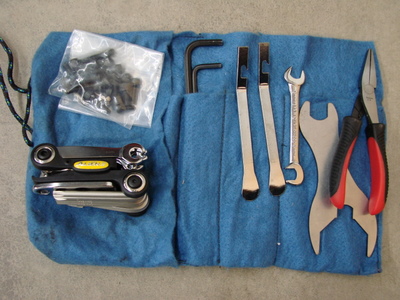 - 30 Days: This Checklist (typically needed for less than 30 Accumulated Rider Days,
This list may contain all that some long term riders carry).
+ 30 Days: Expedition Bicycle Tour Toolkit Checklist for 30+ (Plus) Accumulated Rider Days,
Especially for Groups.
Experience - Be familiar with 20+ Bicycle Tour Mechanical Issues and Solutions.
[ ] Bicycle Multi-Tool / McGuiver Tool / Kool Tool
[combination: adjustable wrench, chain link/break,
Allen/Hex keys {3-6mm minimum}, + & - screw drivers,
and some have basic metric wrenches {8-10mm minimum},
cutting blade, and spoke wrench(es)], more is usually better
[ ] Secure a Swiss Army style knife with a big and small blade,
awl, scissors, bottle & can opener, Phillips tip screw driver,
flat tip screw diver, tweezers.
Our's must also have a cork screw. Comment
[ ] Two un/fastening tools: Two pliers or two wrenches, or one of each.
We recommend: Comment (on occasion we carry all three):
[ ] (1) Adjustable Wrench (5-6 inch)
<PLUS EITHER>
[ ] (2a) Tongue and Groove (NOT heavy duty but light duty OK for bike work
10-12 inches, suggest grind to 8-10") Comments
<OR>
[ ] (2b) Skinny Pliers (5-6 inches)
[ ] Coupler Spanner Wrench [Only for bikes with Tube Couplers]
Notes and Warnings, 20+ Bicycle Tour Mechanical Issues/Solutions
[ ] Nail, No Head: used for removing glass chard(s) from tire flats,
also for Schrader valve air release (1.5 inches x 3-4/32 inch, Finish);
The Awl on a Swiss Army type knife may perform this function.
[ ] Spare Nuts and Bolts (4,5,6,7,8 mm; hex key head bolts,
both long and short, each size), several metric Nuts (especially
in smaller 4, 5, 6 mm sizes; note that metric Washers are
slightly smaller than their inch width counterparts),
and Spacers (if appropriate). Experience (trail touring issue)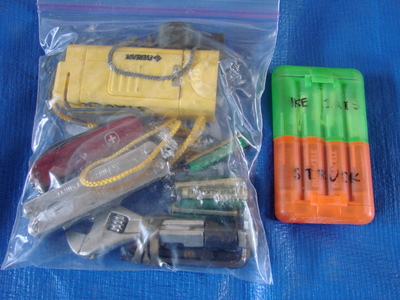 [ ] Phillips & Flat Screw Drivers (often on multi tool)
[ ] Grease and/or Lube Oil Notes/Experience
[ ] Thread Lock Compound (temporary, for bolts, About)
[ ] Rags, Clean. Hint
[ ] Cleaner/Handiwipe, Disposable, Individual Foil/Bag Comment
Tube Patch Kit:
[ ] - Tire Tools (x3 see notes) Notes
[ ] - Self Stick Beveled Edge Patches Caution
[ ] - Scraper/Buffer/Sand Paper Disk and/or Brake Tools
(fine sand paper is best)
[ ] - Small Tube of Rubber Cement Experience
Rehearse & Teach so that every rider will know how to repair a flat tire.
Make any use of Rubber Cement the option after self sticking patches.
How To Warning About Finding the Tube/Tire Leak
About Properly Filling a Tube/Tire More Cool Tricks
Un/Re-Mounting Tricks, Talcum Powder and Comments
[ ] Spare Inner Tubes (at least 1 for each different sized tire,
remember trailer tires too). Experience
[ ] Optional: Talcum Powder or Baby Powder, Comments
[ ] Optional: Grease Pencil or Marker Pencil, Experience
[ ] Phillips & Flat Screw Drivers (often on multi tool)
[ ] Grease and/or Lube Oil Notes/Experience
[ ] Thread Lock Compound (temporary, for bolts, About)
[ ] Rags, Clean. Hint
[ ] Cleaner/Handiwipe, Disposable, Individual Foil/Bag Comment
Tube Patch Kit:
[ ] - Tire Tools (x3 see notes) Notes
[ ] - Self Stick Beveled Edge Patches Caution
[ ] - Scraper/Buffer/Sand Paper Disk and/or Brake Tools
(fine sand paper is best)
[ ] - Small Tube of Rubber Cement Experience
Rehearse & Teach so that every rider will know how to repair a flat tire.
Make any use of Rubber Cement the option after self sticking patches.
How To Warning About Finding the Tube/Tire Leak
About Properly Filling a Tube/Tire More Cool Tricks
Un/Re-Mounting Tricks, Talcum Powder and Comments
[ ] Spare Inner Tubes (at least 1 for each different sized tire,
remember trailer tires too). Experience
[ ] Optional: Talcum Powder or Baby Powder, Comments
[ ] Optional: Grease Pencil or Marker Pencil, Experience Tire/Wheel Care:
[ ] Air Pressure Table (PSI, Atmosphere, Bar, and KSC-kgf/cm2)
[ ] Tire Air Pump Notes Pump Story Caution Experience
[ ] Heavy Duty Manual Pump (Optional: usually stays with transport
vehicle or in the trailer of one biker in a group).
Caution Experience
[ ] Spare Tire and Tire [Repair] Boot, Optional: See Expedition Touring:
Spare Tire and Emergency Tire Repair Boot Discussions
Chain Repair/Reconnect Items: Many Notes
[ ] Spare/Replacement Links and/or Master Links
[ ] Replacement Link Pins
[ ] Chain Holder
[ ] Chain Tool (usually comes on combination tools)
Optionally Kept in Tool Kit (or Elsewhere)
[ ] A small plastic self lock bag with:
[ ] Bandaids/bandage strips, a few of each: small, medium, large
[ ] 6-10 Tylenol (Acetaminophen) Capsules (or equivalent of need)
[ ] Small photo copy of Air Pressure Table
[ ] Emergency Money (Bills and Coins),
[ ] Photocopy of passport and/or Drivers License.
Be careful about Identity Theft information.
Optional: Specialty Considerations Parts/Items/Material:
[ ] Spare/Emergency Rear Derailer Hanger
[ ] Brake Pads (brake repair tools and/or parts, especially more
technical for disk brake and/or hydraulic brake systems,
T-25 Torx Driver)
Tire/Wheel Care:
[ ] Air Pressure Table (PSI, Atmosphere, Bar, and KSC-kgf/cm2)
[ ] Tire Air Pump Notes Pump Story Caution Experience
[ ] Heavy Duty Manual Pump (Optional: usually stays with transport
vehicle or in the trailer of one biker in a group).
Caution Experience
[ ] Spare Tire and Tire [Repair] Boot, Optional: See Expedition Touring:
Spare Tire and Emergency Tire Repair Boot Discussions
Chain Repair/Reconnect Items: Many Notes
[ ] Spare/Replacement Links and/or Master Links
[ ] Replacement Link Pins
[ ] Chain Holder
[ ] Chain Tool (usually comes on combination tools)
Optionally Kept in Tool Kit (or Elsewhere)
[ ] A small plastic self lock bag with:
[ ] Bandaids/bandage strips, a few of each: small, medium, large
[ ] 6-10 Tylenol (Acetaminophen) Capsules (or equivalent of need)
[ ] Small photo copy of Air Pressure Table
[ ] Emergency Money (Bills and Coins),
[ ] Photocopy of passport and/or Drivers License.
Be careful about Identity Theft information.
Optional: Specialty Considerations Parts/Items/Material:
[ ] Spare/Emergency Rear Derailer Hanger
[ ] Brake Pads (brake repair tools and/or parts, especially more
technical for disk brake and/or hydraulic brake systems,
T-25 Torx Driver)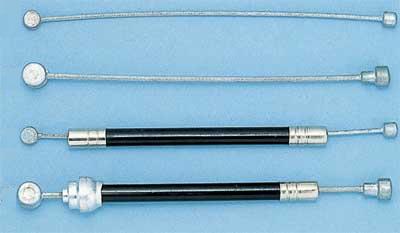 [ ] Long Cables (The Risk)
Warning Notes(1) Notes(2)
[ ] Seat Bolt(s)
[ ] Other Parts and Pieces peculiar to the bike's need or setup
[ ] Sometimes: Specialty Wrenches (for a known size for known
or on going problem, or for special components). Note
Optional: See Expedition/Group Tool Checklist
(especially for 30+ Rider Days)
[ ] Long Cables (The Risk)
Warning Notes(1) Notes(2)
[ ] Seat Bolt(s)
[ ] Other Parts and Pieces peculiar to the bike's need or setup
[ ] Sometimes: Specialty Wrenches (for a known size for known
or on going problem, or for special components). Note
Optional: See Expedition/Group Tool Checklist
(especially for 30+ Rider Days)

Bicycle Camping Checklist,
Fully Loaded Bicycle Touring Checklist,
Self Contained Bicycle Touring Checklist
Bicycle Tour Checklist, Bicycle Tour Planning, About Camping and Related Issues, About Stealth Camping, about wild camping, wild camp, wild camp precautions, bicycle tour checklist, bike camp list, bike camp checklist, bike camp check list, bike camp list, Bicycle camp list, Bicycle camp checklist, Bicycle camp check list, Bicycle camp list, fully loaded camp list, fully loaded camp checklist, fully loaded camp check list, self contained camp list, self contained camp list, self contained camp checklist, self contained camp check list, self contained camp list, bicycle camping, cycling fully loaded, full load bicycle journey, bicycling checklist, velo bici bicicleta travel trip campaign expedition pannier panniers trailer cycle ride riding campain vacation campaigning self contained supporting supported tool tools holiday supplies packing adventures ultralight ultra light cycling camp checklist, About Stealth Camping, about wild camping, wild camp, wild camp precautions, About Bicycle Touring Bicycle Survival Tips and Tricks,
Top, Bicycle Tour Checklist (without Camping),
Bicycle Tour Planning,About Camping and Related Issues, About Stealth Camping
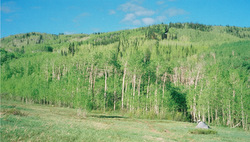 Bike Camping issues and concerns are similar to those of Backpacking.
- Just as Backpacking may be for an overnight, a weekend, a week, a month or a walk about, so goes Bike Camping.
- Just as the pack load may be Ultralight, Light, Medium, or Heavy, so goes Bicycle Camp Touring.
- Just as a Hiker may be Solo, part of a Couple, or in a Small or Large Group, so goes Bicycle Camping.
Cyclists on an overnight or a weekend may travel so light and fast that they may not have a change of underwear or clothing nor have a tent. Long range bikers are looking at durability and survivability as key issues. The issues for either category (light versus durable) are usually indicated herein.
One way to travel light and fast is to NOT camp - Camping is NOT for everyone and camping is NOT for every time. We've done our share of non-camping B&B runs. For those who do camp, please note that separate Backpacking and Vehicle Tent Camping Checklists also exist at this website, plus a separate Bicycle Ultralight Camping Checklist exists. The following is a list or checklist (check list) of what to bring on a bicycle camping tour. One of the pleasurable discoveries about bicycle camping is that one may carry two to four times as much on a bicycle than one may carry backpacking, so there is a range of choices between light and durable.
OBJECTIVE:
Take the LEAST NEEDED Amount/Quantity/Volume that meets the
Situational Requirements.
Every trip has different needs
and everything listed isn't needed for every trip.
----------------------------------------------------------------[ ] Bicycle Touring Checklist, Review Everything (previous list) ---------------------------------------------------------------- Have Quickly Available and Know these Items by Location by Blind Feel [ ] 1 First Aid Kit (Appropriate for Trip Style, Location, Duration, and Store it on the Right-Side) [ ] 2 Lighter (or Magnesium Striker or Waterproof Matches) [ ] 3 Flash Light, Headlight, Lantern, Pod-Light (a.k.a. torch - Tested and Working) [ ] 4 Spare Batteries (Correct Size, in Zip Lock Bag, Ends Protected or Covered by Non Conducting Tape - Prevent Discharge) [ ] 5 Rain / Weather Protection Gear (Appropriate for Climate, Altitude, Season) [ ] 6 Knife (Swiss Army type: big and small blade, awl, scissors, bottle & can opener, and tweezers. Ours, must also have a cork screw!) ----------------------------------------------------------------
Shelter: (1, 2 Choosing/Setting-Up a Campsite; 1, 2 About Stealth Camping; More-Detailed Touring Tips) [ ] Tent, Fly, Poles, Stakes, Line, Line Clips. About Tents [ ] Hammer, Plastic or Wood Stake Mallet (or Combination Hammer/Hand Axe for Adults). Life's Great Irony [ ] Saw, Folding (Way better than Axe for cutting) [ ] Plastic Sheet / Ground Cloth / Foot Print About Ground Cloths [ ] Space Blanket AKA Emergency Blanket. (They Work - Read Instructions, See Notes) [ ] Sleeping Bag(s) About Sleeping Bags [ ] Sleeping Bag Liner (optional) About Sleeping Bag Liners [ ] Sleeping Bag Cover, aka Bivy Sack (optional) About Sleeping Bag Covers [ ] Pillow (optional, Pillow Talk, Case or Small Stuff Bag) [ ] Self Filling Foam/Air Pad, Foam Sleeping Pad, Air Pad, Pump, Pad-to-Pad Attachment Device, Non Slip Material (on slopes, bags slide down hill over time), Air Bed, Pump, Avoid Air Mattresses. About Self Filling Foam/Air Pads [ ] Tie-down Straps, Cord, Spare [Repeated List Item]
Cook Supplies and Equipment, Also See Bigger Cook Equipment Checklist/Page. [ ] Stove, Tested, with Appropriate Connectors, See Stove & Fuel Issues. [ ] Optional: 3+ days, Backup Stove, Stove and Fuel Issues. [ ] Appropriate Fuel for Stove(s), Full/Volume, Spare(s), Check Quantity, Container Condition OK. Stove and Fuel Issues. [ ] Optional Accessories: Aluminum Heat Reflector, Cutting Board, Heat Diffuser/Plate (like Scorch Buster), Carry/Storage Bags, Plastic Bags (zip, quart, gallon) [ ] Cooking Area Fly (optional): Space Blanket, Tarp, Wing, Plastic Cover; with guy lines already attached. Warning [ ] Lighter, Matches in Waterproof Container, Magnesium Striker, Windproof Lighter. It is wise to have at least two sources. Caution Note [ ] Cook Kits, Non-Stick (Pots, Fry Pans, Handles, Covers) [ ] Optional Ware: Coffee or Tea Pot (spindle, basket, lid), Espresso Maker, Coffee/Tea/Herbal ball/filter/mixer, Thermos, Hot Dog Wire/Fork, Grill Basket [ ] Eating Ware (Plate, Bowl, Cup, Knife, Fork, Spoon, Mess Kit, Notes) [ ] Drinking Ware: Bottles, Cups, Mugs, Notes [ ] Cooking Utensils (Spatula, Spoon, Fork, Knife, Large P-38 [can opener]) bottle opener. Some of these things are usually on a knife. [ ] Cleaning Gear (Soap, Brillo, Scrunge or Wash Cloth, Bottle Brush, Pot Pad, Drying Towel (Micro Fiber, Paper), sometimes Bleach/Clorox for sanitation [also used for water treatment]) Caution and Soap Notes [ ] Wash Container(s) Comments (for Dish Washing, Laundry, and maybe Personal Bathing) [ ] Optional Items: Nylon (Kitchen) Carry Bag with sewn loops to hold supplies like Salt and Pepper Shaker, Personal Spices, Soap and/or Sanitizer, Cutlery, Cooking and Cleaning Supplies, Hot Pad, Cutting Board. [ ] Bearbag (aka: Food Robe), Lines / Cable, Throwing Sock; Bear Safe Warning Sustenance, Cycling and Camping, Cycling Only Sustenance,
Tour Caveats#1, Tour Caveats#2 Issues #1, Issues #2, How to Tour Without Cooking, Large Group Hunger Issue Basic Foods (Attn to Food Allergies; A Food Groups Reminder): [ ] Protein: Meat, Jerky, Beans/Legumes, Peanut Butter (or other spread, like Nutella, Humus, deviled Ham/Chicken); Nuts (especially pre-opened Sun Flower and Almond), Milk Products are good protein sources but may spoil quickly (Powdered Milk, Powdered Eggs and Canned Milk last longer; Real Eggs may last a day or two [depends on heat and sun]; Yogurt, Milk, Cottage Cheese, Cheese, and Egg substitute are short lived and are often consumed after purchase), Other [ ] Fruit (Dehydrated, Natural, or Canned), Especially Bananas (no peals on road - very déclassé) [ ] Vegetables (Dehydrated, Natural, or Canned, Green and Orange) [ ] Grains: Cereal, Granola, Oat Meal, many Grain Types Exist, Energy Bars (Types Vary, Experience), some Breads, Trail Mix (different kinds fit different categories), [ ] Carbohydrates (aka Starch, Various Types and Burn Times Exist, usually a person wants quick cooking, long lasting Carbs for evening meals. Avoid processed/bleached foods): Pasta, Bread (Loaf or Baguette, usually wheat or multi grain): Buisquic (or Pre Mixed Baking Flour), Rice Note, Potatoes (Instant, Real) Note Save fruit carbs for morning and enroute meals/snacks. Other Foods and Ready Meals: [ ] Oil (Usually Olive Oil for Cooking, may mix with Vinegar) [ ] Vinegar (Usually Balsamic), [ ] Optional Considerations: Salsa, Salad Dressing, Tarter Sauce [ ] Lemon (Juice / Flavor) [ ] Dehydrated Packets of: Sauce, Gravy, Food Mix (Brownie Mix!) [ ] Dehydrated Meals (MREs, just add hot water) [ ] Other Common Travel Foods: Mac and Cheese, Brownie, Jerky, PBJ Sandwiches, Trail Mix with Almonds and Chocolate Chips
[ ] Water (Water/Sanitation/Health Issues: Clean Water Risks, Filter/Purifier Issues, Sanitize Boiling, Water Management Routine, Water Collection Methods, Cold Weather Warnings/Habits) [ ] Water Bottles, Start Trips and the Day with Full Bottle [ ] Water Bladder(s), About Water Bladders [ ] Water Purifier/Filter (See Water Links above) Beverage: [ ] Coffee, Tea, Herbal Mix, Real / Instant [ ] Juices (Powder or Liquid, Fruit and/or Vegetable), Sodas [ ] Milk or Cream (Skim or Real, Powdered or Canned, Flavored) [ ] Other of choice (like Wine, but usually not carried far) Condiments: [ ] Sugar, Substitute [ ] Salt and/or Pepper (Red, Black, Green, Other) [ ] Hot Sauce, Occasionally: Catsup (Packets or Bottle) [ ] Mini Spice Carousel (nutmeg, curry, paprika ...), Other Favorites
[ ] Navigation Equipment, Listed in Bicycle Touring Checklist. Also see Navigation Tips [ ] Clothing (Off Bike), Experience, BIG Reminder Outdoor/Travel Clothing Checklist On Bike Clothing. See notes on How much to Carry [ ] Shirt(s): [ ] T-shirts with pocket(s) (cotton often OK, as sweat evaporation cools the body, cotton not OK in Cold Temperatures), Tank Tops, Caution: Cotton Not OK for those easily prone to skin infection. [ ] Long sleeve double pocket outdoor type, some are made for sun protection and are yet lightweight and cool. [ ] HD Chamois or flannel double pocket type (often worn as an in camp clothing layer maybe under a jacket) [ ] Pants [ ] Cargo Shorts, Warning [ ] Cargo pants with zipper legs, Warning [ ] Full length, lightweight, for dressier off bike visits [ ] Jeans (heavy, no good if wet, but popular) [ ] Skirt: Quick Wrap Lightweight & Black, has uses [ ] Undies: Bottoms (Regular and/or Bike), Tops (Regular &/or Bra) [ ] Camp Shoes: Cross Trainer, Boots, Sandals, Crocs [ ] Socks (synthetic, NOT cotton) [ ] Sweater, Jacket, Fleece (usually synthetic has less issues) [ ] Swimsuit (most people just use shorts with, maybe, a T-shirt) [ ] Special Consideration Wear (often amazing, have seen suits, negligees, sport-team logo wear, and dresses)
[ ] Toiletry (Remember, this is in addition to the previously mentioned non-camping Medicine and Hygiene listings. Additionally there is a beyond bike camping listing at Comprehensive Toiletry). Also see, doing your own Laundry. [ ] Wash Container(s) Comments (for Personal Bathing) [ ] Washcloth(s) and Towel(s) Notes [ ] Personal Bathing: Solar Shower System (most difficult to setup/manage), or Water Bottle Shower/Bath System (less difficult, Notes), or 1 Pot/Container Bathing System (lightest on supplies), or 2 Pot/Container Bathing System (easiest method to manage). Notes: 1, 2, 3, 4. Also see Laundry. [ ] Toothbrush, Cover/Box/Container, Toothpaste [ ] String Floss (a good emergency sewing thread, usually white but cinnamon red or mint green colors exist), Floss Sticks [ ] Soap and Container (box or bottle, bar or liquid soap) [ ] "P" Bottle [ ] Mirror [ ] Razor/Shaver (may need batteries or charging gear - Have used knife scissors for some trim work) [ ] Comb, Brush [ ] Hair Dryer (optional): Lightweight and Portable. Comments, Story/Joke [ ] Other Considerations: [ ] Flash Light, Torch. It is most convenient, if the bike safely light is detachable and may be used on and off the bike. Spare batteries and bulbs, lamp. Notes. Always know where the flashlight is. [ ] Other Light and/or Heat Source Cautions [ ] Duct Tape (a.k.a. 100 MPH Tape, Electrical, Duck) Duct Tape is Super Utilizable. No single thing has saved more unexpected trip surprises than duct tape.) Story. [ ] Ear Plugs - NOT for Pedaling (About Camp Noise - From Bruce L) [ ] Large curved carpet/tent sewing needle and HD carpet thread (floss works too - usually white but red and green colors exist). [ ] Electricity Plug Adapter (sometimes needed for other countries)
 The reader is looking just at the Bicycle Camping portion of the
Bicycle Touring Checklist.
The reader is looking just at the Bicycle Camping portion of the
Bicycle Touring Checklist.There are four other Camping Checklists that one should be aware (just for reference information):
- Ultralight Cycling Checklist
(Based Aaron Teasdale's Adventure Cyclist article about
Matthew Lee, Two time Great Divide Trail Race Champion) - Backpacking Checklist (which is quite similar to the Bike Camping Checklist)
- Camping Checklist (for regular "Tent Camping" using a motored vehicle to carry supplies)
- Group Equipment Checklist (for extended Family/Group Type Summer Camp Outings)
but these items are typically not brought in Bike Tours where one carries their own gear:
Clothing, Toiletry, or Personal Items Checklists.
It is a way of saying we are passing through with no thought of invasion or conquest,
only the simple will to share a part of the world" - Claude Herve
Bicycle Trip/Travel/Tour Optional Items Checklist
 Top
Top
Each of these items are something that we carried at least once,
or we wished we had the item at one time.
[ ]Schrader to Presta air pump valve converter (a wiseinvestment), also consider pre-adapting a Presta rim hole (drillout and insert a Schrader-to-Presta shim sizer) [ ] Specialty Tools: Carry for one's self or for shop technicians who may be in remote locations and may not have the tool. Many different kinds and types of tools exist. What matters is: o What tools fit the bike's component(s) or special tool requirements? o What issues, common problems, or likely problems will arise with the particular tour bike(s)? See: 20+ Common Touring Maintenance Issues and Solutions o 90+ day Adventure Cycling Guides/Leaders actually carry 10-15 pounds of tools (most are listed in the Expedition/Group Tool Kit Checklist). See/visit for a tools/equipment reminder [ ] Cell / SAT Phone, 2 Way Radio, charging system, cables, batteries, solar charger (optional), SIMM Card,
electrical connector adapter (foreign country), appropriate area network and roaming coverage. Caution [ ] GPS Navigation Device, cables, batteries, electrical adapter (foreign country), mount (optional),solar charger (optional), proper map code/network/agreement(s). Issue [ ] Music System (analog/digital - may be an accessory to a cell digital phone system), Radio, Batteries, Ear Pieces, Case, Memory Stick/Device, solar charger (optional), Charging System (plugs/adapters, cords, cables, up/down load), Warning (Off Bike Only) [ ] Camera(s) (case, batteries/spares/charger, film/storage, lenses/filter download cable/material) Story [ ] Extra Plastic Bags, Press/Zip Seal (Lg, Med, Sm [Qt, Gal] Zip) [ ] Hardcopy (Also see 'Download', the next item - more and more documents, maps, receipts and instructions are digitized and are worth carrying): [ ] Bicycle Owner's Manual, Repair Manual, [ ] Bicycle Packing/Shipping/Assembly Manual/Checklist
Bicycle Shipping/Ownership Document [ ] Name and Travel Contact Information, Telephone (home and travel) [ ] Itinerary, Travel Documents, Booking Confirmations/Numbers/Receipts [ ] Health/Medical Insurance/Assurance Documentation/Card Phone/Agent [ ] Travel Insurance/Assurance Documentation/Card/Phone-Number/Agent [ ] Download (into one or more memory device(s), like a Flash Drive, NoteBook, NotePad, Travel Computer, Camera, Phone/Pod/Personal Display Device): [Anything digitized from the previous item of 'Hardcopy']: Bicycle Owner &/or Repair Manual (Bicycle, Trailer, GPS, Phone, Stove(s), Bike Computer, Notebook/Pad, Watch); Reservations, Itinerary, Places to Stay, Flight Info, Shipping, Insurance; Photo Image/Copy (Passport, Health Rcds, Any/other Hardcopy documentation, Maps ([travel, tour, city, transport, schedules]); Bike Touring Checklist; Bike Shipping Checklist, Music/Entertainment, Emergency Home/Fam/Biz/Med Contact Info); Travel Related Links/Favorites; Complex Password Secure; Important Note, * * * Copyright Notes * * * [ ] Backpack, Light Duty or Laundry Net Pack. Carry Stuff off the bike, some panniers may convert to off bike packs (carry the strap material) [ ] Nylon Cord, Parachute Cord, about 50 feet but 50 yards is better. Uses [ ] Spiral Top/Back/Side Note Pad, Diary/Journal, Pen/Pencil (small set of colored pencils). Comments Old Space Race Joke [ ] Book, Reading (especially for travel wait times like an airport ...) [ ] Name/Business Cards Yours/Spouse/Boss/Friend [ ] Repair Kits / Parts / Tools: Tent, Pole, Mattress, Stove, Pack, Spoke, Clothing / GoreTex Sewing Kit, Inner-Tube, Tire Patch, Chain, Pannier Parts. [ ] Collapsible Walking Stick(s) [ ] "P" Bottle "Y" Funnel [ ] Cleaning Basin (Plastic/Nylon, Rubberized Cloth, Inflatable, Foldable/Packable) Experience [ ] Espresso Mini Camp System. Device, Coffee, Water, Heat Source. Caution [ ] Astronomy: Charts, Telescopes & system s/w and h/w [ ] Night Vision Device/Goggles [ ] Binoculars, Lightweight or Heavy Duty, above 5x need stabilization (gyro, monopod, tripod, or gorilla-pod) [ ] Super Glue (handy for many field repairs, but don't use as a Thread Lock, see Thread Lock) [ ] Personal Protection Device, Bear Spray (typically legal ONLY in the USA), Dog Spray (check with authorities) [ ] Air Horn (sports type that will fit in water bottle cage, rechargeable with air pump.) Cool Notes! [ ] Mascot / Stuffed Animal / Totem / Symbol, Notes
Expedition Bicycle Touring Checklist and Issues:Expedition Bicycle Touring Checklist and Issues, Bike Tour, Bike Touring, Bike Tours, Fully Loaded Bike Tour, Trans Continental Bike Tour, Great Divide Mountain Bike Route, GDMBR, Self Contained Bike Tour, Campain Bike Tour, Campaign Bike Tour, Campagne Bike Tour, Camping Bike Tour, Bicycle Tour, Bicycle Touring, Bicycle Tours, Fully Loaded Bicycle Tour, Trans Continental Bicycle Tour, Great Divide Mountain Bicycle Route, GDMBR, Self Contained Bicycle Tour, Campain Bicycle Tour, Campaign Bicycle Tour, Campagne Bicycle Tour, Camping Bicycle Tour, Bike Travel, Bike Traveling, Bike Travels, Fully Loaded Bike Travel, Trans Continental Bike Travel, Great Divide Mountain Bike Route, GDMBR, Self Contained Bike Travel, Campain Bike Travel, Campaign Bike Travel, Campagne Bike Travel, Camping Bike Travel, bike touring, bicycle touring, bike tour, bicycle tour, bike touring checklist, bicycle touring checklist, bike tour checklist, bicycle tour checklist, bike touring 101, bicycle touring 101, self contained bike touring, self contained bicycle touring, self contained bike tour, self contained bicycle tour, fully loaded bike touring, fully loaded bicycle touring, fully loaded bike tour, fully loaded bicycle tour, Fully Loaded, Self Contained, Camping Tour, Cross-Country Tour, Long Bicycle Tour Checklist, Long Touring, Bicycling, Cycle Touring, Expedition Bicycle Checklist, Bike Tour Gear List, Bike Checklist, Bike Packing Checklist, , Bike Ride, Bike Riding, Bicycle Ride, Bicycle Riding, Bicycle campain, campaign Bicycle Campaign, Bicycle Campaigning, Bike Travel, Self Supporting Touring, Self Supported Bike Tour, Bicycle Tool Checklist, Cycling Holiday Checklist, Cycle Touring, Bicycle Camp Checklist, Bike Camp Checklist, Cycling Bike Camping Supplies, Bike Camping Gear, Packing Checklist, Bicycle Tour Packing Checklist, What to Pack for Bike Touring, Self Supported Touring by Bicycle, Self Supported Tour by Bicycle,
 Top
TopFor the Actual Mechanics of the Tour: Do, or Have Done, or Review everything as follows: For the Tour's Preparation:
 Planning the Bike Tour Itself
- Planning How to Get There
- Familiarize one's self with the Bicycling Travel Tips, Hints, and Tricks of the Trade..
- Read the About Touring Travel Style, Observations, and Hints.
- Learn about Cultural Issues and Differences in the
Travel Tips, Hints, and Lessons Learned
(different from Bicycling Travel Tips Section) - Many places online or in book stores. - This is the beginning. Also, of course, learn about the destination and as
a minimum,
teach one's self the basic language words (more is better). - May the wind be at your back, nourishment plentiful, and interactions rewarding.
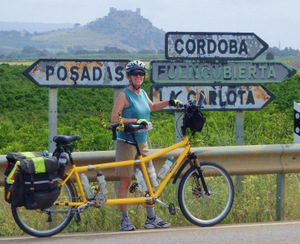
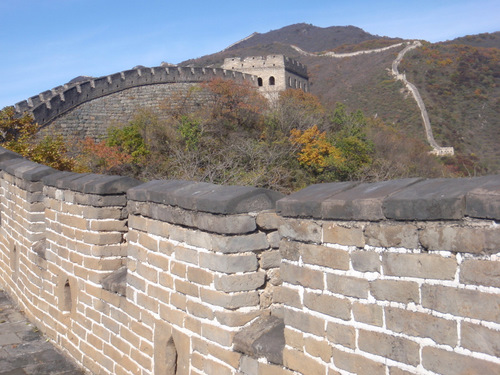 Our Experience: We have 37,000 miles of Touring Experience. See our Bicycle Tour Adventure Stories. We have heavy duty camping experience since 1965 (Eagle Scout, Leadership, Military, Survival and all that stuff). We have camped from bikes since 1995. Camping with bikes is a natural progression from backpacking, but it was necessitated by foot problems which more or less ended long distance hiking and backpacking for us.
Expedition Touring is generally defined as 30 or more continuous days on the road.
 Therefore, Durability and Reparability become much more important factors for Touring Survivability than Light Weight or Performance oriented issues. Steel components rule because they are more durable and in the remote reaches of the world, they are more easily Repiared [not that many aluminum aircraft welders around the world, nor carbon fiber technicians]. On expeditions, one needs to be able to perform their own maintenance, adjustments, and repairs on not only the bike equipment but on all equipment (stoves, tents, poles, ...) or someone in the group needs to have this knowledge or else ... (Doom).
Web-Sites with touring stories and travel lessons: Tour Tales (travel logs), CycloCamping (blog forums, travel info, goods), Ivan Viehoff (long int'l tours), Dogbait's Babel (Ausie Travel Humor - retired Postman, met in China), Ray F (Ray is a friend that I met at BBI/Colorado, who writes [mainly in Italian or German, some English], who rides recumbents and used to sell recumbents from his Bike Shop which is now closed as he is traveling and he uses the old web site's URL as he still owns it); and Our own.
Bicycle Expedition Long Term Travel Issues Checklist
TopGroup Issues (often related): Organization, Communication, Camping, Supplies/Equipment, Food, and Planning.
Common/Typical International Travel Issues (Next Section).
These items and considerations are in addition to the Main Bicycle Tour Checklist and/or the Optional/Additional Touring Items. There are shades of gray between what a solo rider needs and what a group needs. There are requirement differences between local country tours, foreign country tours, and foreign continent tours. Review this list and review the following Expedition/Group Tool Kit Checklist, select as needed.
[ ] Carry a list or directory of known good bike
    mechanics/shops for towns, cities, and areas
    where one will be touring:
[ ]   Adventure Cycling's Yellow Pages, by Continent
      (To say this delicately, Adventure Cycling's Yellow
      Pages are not complete by any means, but they are a
      start, and they offer more and more information each
      new year). Adventure Cycling's Annual Cycling Yellow
      Pages paper magazine, presently, has places, ideas,
      and support listings that cannot be found at their
      online source, so it's worth looking at or securing
      a copy (or back copy).
      One may even find a link back to this page.
[ ]   Web Search (shops, local/regional organizations/clubs
      for the destination cities, areas, and country as
      well as places to stay or see [why we tour]. Also,
      there are tours for hire that take weeks or even months in exotic locations).
[ ]   Read/View Bicycle Tour Books, Touring Blogs, Touring Journals
      (more and more online now) and sometimes a Bike Club
      may have sufficient enough trip notes to advise where to stay,
      offer route and lodging considerations, and denote special
      issues.
[ ] Know Cyclist-to-Cyclist Communication Signals and
    Decision and Remote Communication Issues. Most touring
    is conducted with other people and it is beneficial for
    everyone to recognize or facilitate different kinds of
    Communication Issues and Solutions.
[ ] Schedule some Down Time and some away time
    for many good reasons:
    1) After the initial planning, it seems that nothing
       ever happens to put a tour on time, on track,
       and on schedule.
    2) People need breaks from people,
       especially in groups of three plus.
    3) Planned down time is good mental health.
    4) Facilitates unexpected events, like for being sick
       for a day or two, or to heal a sprained body part.
    5) Facilitates different people to follow their
       own interests.
    6) Down days allow for optional side trips.
    7) Facilitates bike maintenance (self or shop).
    It seems that one planned down day per week keeps
    a group healthy. Try to schedule where other
    interesting side trips may occur. Down days seem better
    served in cities and major villages rather than in the
    outback (but there are exceptions).
[ ] Schedule Maintenance Stops with known good
    bike mechanics/shops (&/or do yourself, but know when
    to take advantage of passing through a city with bike
    shops and bike parts/supplies)
[ ] Expedition Tool Kit
    (See Expedition/Group Tool Kit Checklist
    Down-Scroll yet). Review the list and choose as needed,
    1 to 4 cyclists often ride much lighter, tool wise, than
    a group of 14-18 riders (everything else being equal).
    Remoteness matters (more remoteness requires more risk
    preparation).
[ ] A way to get money, if needed. We have prearranged
    money pickup at a Bank. This also is a risk reduction
    measure, in case of loss, robbery, or too many good
    bargains. While on the subject of bargains, on road
    trips/tours we have been known to have items
    delay shipped to our home - They have always
    come through, 100% (6 months later, once).
[ ] Cell Phone - Smart Phone, International/Regional,
    with a network plan that works in the touring area(s),
    SIM Card (Caution: All American Cell
    Phones are locked to the sellers plan/SIM Card;
    Phones may be easily unlocked via a code-series
    of numbers [Internet Search for codes - the purpose
    is for the traveling cyclist to be able to use their own phone in a foreign
    country, region, or continent using a rented SIM Card and Local Phone Plan];
    Charging system and cables, electrical plug adapter, stored power
    supply/re-charger(like power monkey), solar charger,
    key telephone numbers (home, destination, travel, ..).
    Power Note: Some cyclists deliberately stay at
    facilities that have electricity every 2 or 3 days
    (campground, pension, hostel), in order to re-charge
    all of their power supplies and spare energy storage
    devices. There are front hub dynamos that may charge
    a power cell that fits in the handlebar stem
    (or something similar, with USB ports) that charges
    smartphones, cameras, and/or computers
    (more and more to smartphones).
    Satellite Phones are approaching purchase and rental
    costs worthy of consideration. Their advantage is that they
    operate in lieu of local blackouts (earthquake, political),
    cell reception (a remote issue), tower failures, and they
    bypass local coverage rules and plans. Satellite Phones
    still require line of site communication (like from
    open areas and roof tops) and they still have
    interference problems in bad storms, high wind
    conditions, and solar events.
[ ] Stoves: Bring Two Stoves. Stove Issues,
    Travel Issues to Consider, Stove Selection Issues,
    and Things to Know.
    FACT: The most common and accessible fuel on the
    planet is Unleaded Gasoline.
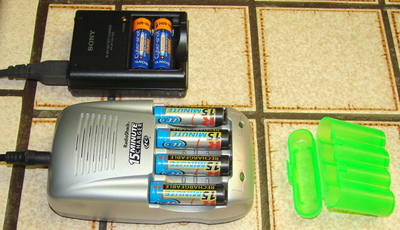
[ ] Battery Charging Issues: Keeping batteries charged
    becomes important and a big part of the regimen when
    one may find electricity.
    - One issue is that some outback huts/shacks/shelters
    may only have one wire to a light socket but no outlet.
    Tim and Cindie Travis of downtheroad.org have learned
    to carry a screw-in lightbulb extension with a power
    outlet socket. Of course one still has to deal with
    110 or 220 volt issues. AA battery chargers are either
    110 or 220 volts (not dual yet). We have one of each
    and will carry both or what is appropriate for the
    travel region.
    - Computer charge adapters will work on either voltage
    (automatically), one just needs the correct electrical
    plug in adapter.
    - We sometimes carry a 3 way extension plug-outlet,
    it is more for waiting areas (bus, train, plane,
    lobby, ...), such that if someone has already plugged
    into the only outlet, we can plug
    them and us into the same extension plug.
    - Note that AA batteries are the most common battery
    in the world and that the more items that operate on
    AA, the less one has to deal with different battery
    charge adapters and one may buy regular AA
    batteries at a store/market/roadside vendor. If the
    charging unit or one's capability to charge, ceases, then one
    cannot buy special camera or phone batteries just anywhere.
    - Most large electronic stores around the world (like Radio
    Shack in the US) and electronic stores in international airports
    sell 15 minute quick charge systems, which uses Ni-MH
    as an abbreviation for Nickel-Metal Hydride, and extra
    15 minute quick charge batteries. We've had very
    good luck with these batteries and the batteries
    themselves charge up the same regardless of being
    charged by a 110v system or a 220v system (the same
    batteries may be used for either voltage system).
    However, the charger's voltage must match the local
    voltage.
    - Ni-Cad is so NOT the same thing as Ni-MH and they
    CANNOT be substituted - There are Dire EXPLOSIVE
    consequences.
    - It is  not unusual to carry two batteries for each
    specialized camera, phone, music unit or combination
    unit.
    - Bring all of the appropriate adapters and cables.
    CAUTION: For those cyclists that own different cameras, be sure
    to bring the correct download cable(s) and/or adapter(s)
    that match the selected camera(s). This is particularly
    a problem with non-standard and proprietary equipment (like Sony).
    - Label the cables and/or adapters, we've brought the wrong
    USB-Camera cable for the carried camera, more than once.
    - Solar operated chargers are being used with more and
    more frequency, especially for phones or devices with
    USB ports (read instructions carefully).
    - Some (better) hotels have energy efficient rooms with
    magnetic key card slots for the I'm Home mode. When
    the occupant removes the card to go out, all of the
    electrical outlets will turn off, thus the battery
    that was set up for charging while one was out
    is NOT Charging at all and in some cases it may be
    discharging. Ask for a second room key card but note
    that in most cases any square piece of paper or
    cardboard placed in the slot will activate power to
    the outlets.
[ ] Saw: Required (We have done well with a Japanese
    fold-up knife style garden saw (Garden Centers). Many
    outdoorsmen prefer foldup bow saws (found in
    Camping or Hunting Stores).
[ ] Spare bike gloves Comments
[ ] Duct Tape: 2 inches wide, colors are available at better hardware
    stores and camouflage is available at better sporting or hunting
    stores). Some people, not us, put long wraps of duct tape onto
    their bike frame and/or trailer frame, at one or more
    locations. No single thing has saved more tours, than
    duct tape.
[ ] Nylon Cord: Something about 1/8 inch (~5 mm), at least
    50 meters/yards.  So far, used for human and bike
    emergencies, lashing repairs, makeshift bear bag,
    water well bucket dipping, bike tow rope in a
    6 inch deep slow mud road (duct tape used also for
    hand grip and shoulder strap padding). Parachute Cord
    is perfect, found in hunting stores and some surplus
    stores (usually white, sometimes olive),
    a yellow variety may be found in better hardware stores
    (construction). Nylon Cord is always a(n) appreciated
    trade or gift item in the outback/interior.
    In most cases, it is wise to carry extra.
[ ] Tire Air Pumps, be sure that the pump fits the bike's
      air valve type(s). Warnings
    For Supported/Sagged Tours (or in nearby vehicle):
      Air Pump Canister, fully pressured or electric
      operated with electricity (DC or AC) source &
      connectors and/or Heavy Duty Manual Stand-Up
      Pump (one for group), Air Pressure Guage
      (often built-in).
    For Self Supported Tours:
      Bike sized pump Warnings
      Regulator Air Valve and extra CO2 cartridges
       (Carry out the empties),
      Pressure Guage, and/or Spare Pump.
      Note: Many countries use different Air Pressure Scales.
[ ] Laundry Issues: Discussed at Bike Touring Tips and Tricks
[ ] Lube(s) (Chain Oil, Bearing Grease)
[ ] Basic Sewing Kit, plus canvas hooked needle, tough canvas thread
    (Dental Floss is a good emergency sewing thread)
[ ] Sag Wagon Arrangements
[ ] Trip Plan with Friend, Officials
[ ] Visitation Arrangements, Permits, Directions
[ ] Monetary/Denomination/Conversion Arrangements
[ ] Manuals, Compact (or copies of key pages).
    Assembly/Packing checklist/instructions, more and
    more these things are put into mass digital storage,
    especially smart phones and light weight digital
    devices to include cameras.
[ ] Clean Rags in Zip Lock bag (for cleaning dirt or chains).
    Note: We almost always come across a clean cloth/rag/
    shirt/towel daily on the road side.

Foot Note (Pun Intended): Can't quite explain why but
expedition bikers tend to wear hiking shoes or boots
instead of bike shoes and it is common to see them in
regular out-of-doors clothing thatis fit for the
climate(s) and region(s). Addendum - It often has to
do with snow covered mountain passes, rocky mountain
roads, floods, marshes, rain, mud, hot sand, and
walk-pushing a damaged bike.

Field Note Bicycle Travelers often dress similar
to the local people (because there is a Geo-Physical
reason for the local dress style).
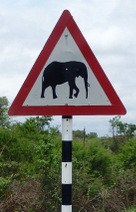
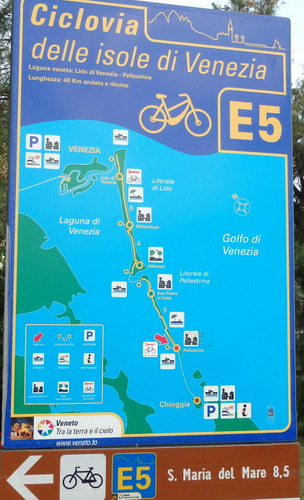

The percentage of Africa that is Wilderness: 28%
The percentage of North America that is Wilderness: 38%
Subject to definition, yet interesting.
International Travel Issues and International Bicycle Tour Issues
Top, Expedition Long Term Travel Issues (Previous Section).- Most of the world uses 24 Hour Time. See Time and Travel Timing for Time related tips and experiences. Also know about Time Zones.
- Money and Measures: The separator and the radix may be different in other countries, particularly in Europe. In the USA the separator is a comma, in most of Europe the separator is a dot/period. In the USA the is a radix (also called a decimal point in base 10) is a dot/period, in most of Europe the radix is a comma. For example:
- One thousand Dollars in the USA is written as $1,000.00
- One thousand Euros in Europe is written as €1.000,00
For us, learning numbers and performing math in other countries/languages gets complicated in a hurry. We have learned to write down numbers and to have other people/merchants write down numbers, thus 99% of all money related misunderstandings go away. - Carrying Note Pad and Pencil makes life on the road whole lot simpler. Drawing, Pictionary, and Charades skills will enhance communication effectiveness.
- Words and Numbers: We've been at a place where a 7 (the number Seven) was not recognized until a dash was placed through it (
 ). We've also been at a place where a 1 (the number One) wasn't recognized until a little diagonal tick was placed at the top (
 ). We've asked for directions to a written street name that we wrote down, but we didn't copy and write the appropriate acute/diacritical marks, and the word was not understandable by any locals until the proper accent marks were added to some characters, then a big 'Ahhh' sounded and we were finally understood and helped (for a made up example, Rakozi is Not the same as Rákózi - the words are mentally strange to one another).
- See Currency, Exchange, Money Management, Experiences, and Horror Stories.
- Most of the world uses Celsius (Centigrade) for Temperature Measurement.

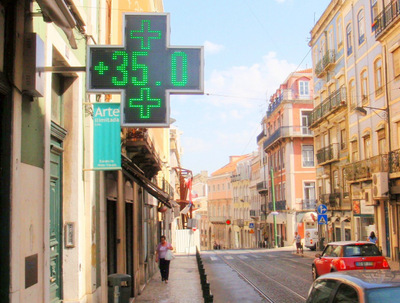
See Celsius (Centigrade) for Temperature related tips and experiences. - Different countries and areas use different tire (or tyre) Air Pressure Measures.
See International Air Pressure Measures and Equivalence Table
for a brief introduction to the various measure types and how they equate to one another. - Different countries and areas use different Weights and Measures;
See Weights and Measures for an exposure to (mostly metric) weights and measures and some tips and experiences. - We have a list of odd experiences, cultural differences, communication issues, and transportation observations that are worthy of quick review, at Travel Experiences. The list is not complete but it is really good for first time travelers (regardless of mode of transportation).
- There are a host of Travel and Flight Issues with Stoves and Fuel.
- See the TSA website for Permitted and Prohibited Items for Carry-On and Baggage-Check: www.tsa.gov. Many (most) other countries are stricter than the USA, especially those countries which have had many Terrorist problems.
- How to Ship and/or Pack Bicycles for International Freight or Airline Transport.

- Dan Buettner, on beginning his 12,000-mile, 277-day ride across Africa
Bicycle Tour Tools (30+ Days)
Bicycle
Expedition Tools Checklist (30+ Days)
Bicycle
Expedition Tool Kit Checklist (30+ Days)
Bicycle
Group Tool Kit Checklist (30+ Accumulated Rider Days)
Bicycle
Tool Checklist and Considerations (30+ Accumulated Rider Days)
Top- 30 Days: Bicycle Tour Toolkit Checklist (typically needed for less than 30 Accumulated Rider Days,
This list may contain all that some long term riders carry).
+ 30 Days: This Checklist for 30+ (Plus) Accumulated Rider Days, Especially for Groups.
Experience - Be familiar with 20+ Bicycle Tour Mechanical Issues and Solutions.
Also Related: Group Touring Issues (Organization, Communication, Camping, Supplies/Equipment, Food, and Planning).
Tool and Part Standards:
Tool Carrying and Distribution: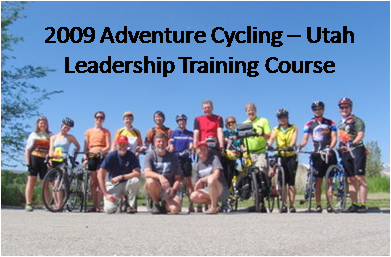 In traveling groups, there is usually no need to carry duplicate specialty tools. Many self-contained groups just divide the tools among themselves. However ... Caution: Sometimes, bikers part ways or loose bikes or equipment (for a variety of reasons). The concern is when the parting biker has/had a special tool or something else that the group needs or will need (tickets, keys, codes, telephone numbers, ...). Tools are heavy, and it is nice to share the load on an expedition. We're not recommending that expeditions carry all of these tools, but these are the common/typical tools carried on expeditions - The following checklist is very close to the Adventure Cycling standard issue Ten to Twelve Pound Expedition Tool Kit for Guides/Leaders to carry. Makes one want to Hug a Leader and say Thank You for carrying that for me!
- Phillips Screw Drivers: #1, #2, Experience - Always know the size/type/fitting of your tour bike's derailer limit screws.
- Flat Tip Screw Drivers: Big, Medium, Small
- Metric Hex Keys: 2, 2.5, 3, 4, 5. 6, 8, 10mm (speed keys) Note
- Torx Keys: T7, T25, T40, Note
- Gripper Tool(s):
- Pliers, 6" (optional if Tongue and Groove Pliers)
- Tongue and Groove Pliers, Comments
- Wrenches, Multiple Functions:
- Adjustable Wrench: 8 or 12", Comments
- Headset Wrench (32 & 36 mm most common; some 40 & 30 mm)
- Open End Wrenches (or Combo Open and Box End): 6-17mm, Note
- Pedal Wrench 15mm, Comments
- Cone (hub bearing)/Axle Wrench: 13-19mm (Comments - 15mm most common, then 14 & 13)
- Spoke Wrench (3.23mm, 3.30mm, and 3.45mm sizes will fit 98% of most needs,
3.23mm is the most common nipple size and it may be found on some multi tools
(it's Park Spoke Wrench Tool color is Black). Notes
Optional: Park does make a ~$40 universal clamping spoke wrench that seems to work on any spoke nipple/nut and it often times works with otherwise rounded or stubborn spoke nipples. - Bottom Bracket Wrench/Spanner/Fitting/Tool
- Crank &/or Crank Bolt Wrench, 14mm socket
(with Nut Drive Head so as to use Adjustable Wrech [first] or Channel Locks [second]) - Cassette Lockring Tool/Wrench &/or Freewheel Tool/Wrench (as appropriate,
Shimano and Campagnolo each have a standard tool) - Chain Whip (for removing rear cogs, cog sets and sometimes crank rings; Chain Whips tend to break over a short period of time and most shops are now purchasing Cog Grips [my name, also Vice Whip] which are curved plastic grips on a vice-grip kind of handle - Chain Whips are lighter and smaller to carry but may only last as little as about 10 field uses but are often justified by cost, space and weight savings; cog grips tend to be pricy, slightly heavier, take up a little more space but last longer)
- Specialty: Frame Coupler Wrench/Spanner/Tool (as needed, like S&S type, 2 sizes)
- Needle-Nose Pliers with Wire Cutter (not quite as good as wire nipper; Hint: wrap once with [any|duct|surgical] tape, then cut)
- Air-Suspension Pump, if needed
- Tire Pump (Schrader & Presta; Dunlop), Personal Pump is sufficient but
sometimes a group may carry a multi-valve standup pump (grease internal bellow every other year or per care instructions) - Tire Levers/Tools (plastic is light and user friendly, metal does not break - We've broken good plastic tire tools on cold days)
- Spare Tubes (appropriate for tires, Schrader/Presta, main wheels and trailers, use duct tape for a rim liner or rim liner repair).
- Spare Tire(s): Bike and Trailer, usually a light weight, used,
slick that will just get someone to a bike store in a day or two,
Issues(1), Issues(2), Observations and Repair Notes - Tire Patch / Tire Boot (Options & Considerations to temporarily repair torn tires, often duct tape will suffice)
- Grease Tube, Small 2 oz
- Lube Oil, Small Bottle with Drip Straw, 2 oz
- Rags, Comments
- Spare Chain (good just as backup but also allows alternating chains for Penatrant cleaning liquids to evaporate/dissipate, i.e. rotate cleaned chains, allow 24 hours between cleaning an lubing if using a Penatrant)
- Sprocket Cleaning Tooth and Chain Brush (a very handy tool for long range biking - 1 per group)
- Chain Break Tool (Notes, with two Cradles/Mounts, often on multi-tool)
- Chain Connectors: Spare Link Pins, Comments, short chain segments, Master Links: 7-9 speed, 10 speed, other
- Chain Holder
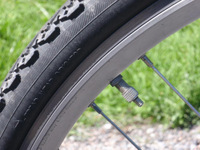 Spare/Emergency Rear Derailer Hanger
- Long Cables (shift and/or brake, universal, appropriate end/terminals
for bikes on hand,
Housing and Wire for the longest reach necessary - Hint, bend housing for the cut - significantly reduces wrap fray) - Brake Cable(s): Warning, Notes(1), Notes(2)
- Derailer/Shifter Cable(s): Warning, Notes(1), Notes(2), See Derailer Field Notes in the Touring Tips page.
- For some tandem/large bikes or emergency cable break repair, interim cable connectors (for brake and shifter).
- Tin Snips, Wire Cutter, Nippers (Common for repairing tent pole, racks, stays, and cable/wire breaks or trims. One per group. On occasion, a metal-can may be cut and shaped for a temporary fix - "Hobo Engineering." Be careful with ragged edges, sometimes pliers may be used to bend edges back and over to not expose sharp edge.)
- Cable Ends/Caps/Terminals (just a few, there are different sizes, but in the field - whatever works, including heat shrink)
- Brake/Shifter Ferrules (shifter type works for either, brake type cannot be used on shifter)
- Brake Pads (for disks too): Hydraulic Issues/Caution, match existing when practical
- Schrader Valve Core Threader/Remover Tool and some spare cores
- Hacksaw (new blades and holding device, wrap teeth with duct tape)
- File(s), Small: Half Round and Triangle
- Knife (often a Swiss Army type, with: big and small blade, awl, scissors, bottle & can opener, Phillips tip screw driver, flat tip screw driver, tweezers, and bottle opener - optional/mandatory: cork screw.)
- Awl (often on knife, used to reset housing holes or for other camp equipment repairs like tents, panniers, flys, or rain jackets)
- Duct Tape (2 inches wide, colors are available at better hardware stores and camouflage is available at better sporting or hunting stores). Some people, not us, put long wraps of duct tape onto their bike frame and/or trailer frame, at one or more locations. No single thing has saved more tours, than duct tape.)
- Wire, general braded, picture frame size/style (30 inches), for emergency repairs. Sometimes, a segment of uncoated coat hanger (in the field, sometimes paper clips work).
- Plastic Heavy Duty and Medium Electrical Zip Ties (Especially if the bike already has zip ties (typically to hold cables, sometimes for bike computer sensors, and since zip ties are about 1mm thick, in the field, they may also be used to help set the spacing of brake pads/calipers - Cat).
- Spare Parts: nuts, bolts, washers, spacers [Nuts and Bolts (4,5,6,7,8 mm; hex key head bolts, long and some short), several metric Nuts (especially in smaller 4, 5, 6 mm sizes; note that metric Washers are smaller than their inch width counterparts), and Spacers (if appropriate). Sometimes spare skewers and common trailer connecting pins or pieces. Wally Werner (AC Expedition Tour Leader) also carries spare Bob Trailer headset bottom bolt pieces.]
- Spare chain (individual bike fit issue, chains wear out twice as fast on trailers and rear tandem drives)
- Optional: Large/Xtra-Large binder Clip. Consider using an Extra Large Binder Clip and a Stick or Wire on a chain stay or a seat stay, or use Duct Tape and a stick or wire for emergency wheel truing work (along with the proper Spoke Wrench). Note that in most cases, the field work is just to get the wheel in good enough shape to get out of the field and into a bike shop. It is given; that most experienced wheel persons could eyeball a good enough wheel true without an indicator.
- Optional: Spare spokes (Notes, individual bike fit issue, rear often has two different spoke lengths (dishing effect), emergency spoke replacement kit - keep instructions)
- Optional: Adjustable Pin Spanner, regarding Eccentrics
- Optional: Spare Derailer(s) / Dérailleur(s)
- Optional: Small Locking Grip Pliers (like Vise Grips)
- Optional: Little Hammer, Combination Flat and Ball and/or Plastic Tipped (we sometimes carry a plastic stake mallet)
- Optional: Scissors (often on knife)
- Optional: Spare Brake Rotor, Notes (different sizes exist 6, 7, or 8 inch Diameter [or 160, 180, 207mm], 8" is usually for tandem, other sizes exist, must have correct size and matching bolt pattern, most use T-25 torx drive, other types exist)
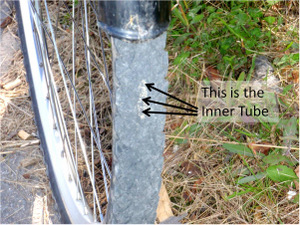
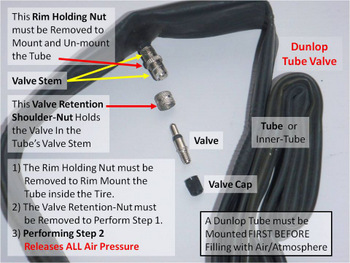
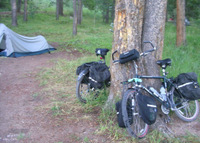

- Dennis Struck, on the Zen like characteristics that may accompany bicycle touring.
About Bicycle Packing, Shipping, and Transporting

 All About Bicycle Packing, Shipping, and Transporting
The Bicycle Packing, Shipping, and Transporting information
is so voluminous, that it grew into its own web page.
PS, These two pictures were actually taken on the same day!
 "Our Club is really an Eating Club
with a Cycling Disorder"
"Our Club is really an Eating Club
with a Cycling Disorder"- Allen Beauchamp, about the Colorado Springs Cycling Club
About Bicycle Touring and Bicycle Tour Issues
About Bicycle Touring and Bicycle Touring Issues
About Bicycle Touring and Touring Issues
segment became so large (and tough to maintain),
that it grew into its own web page.
About Bicycle Touring
Tips, Lessons Learned, and Tricks of the Trade
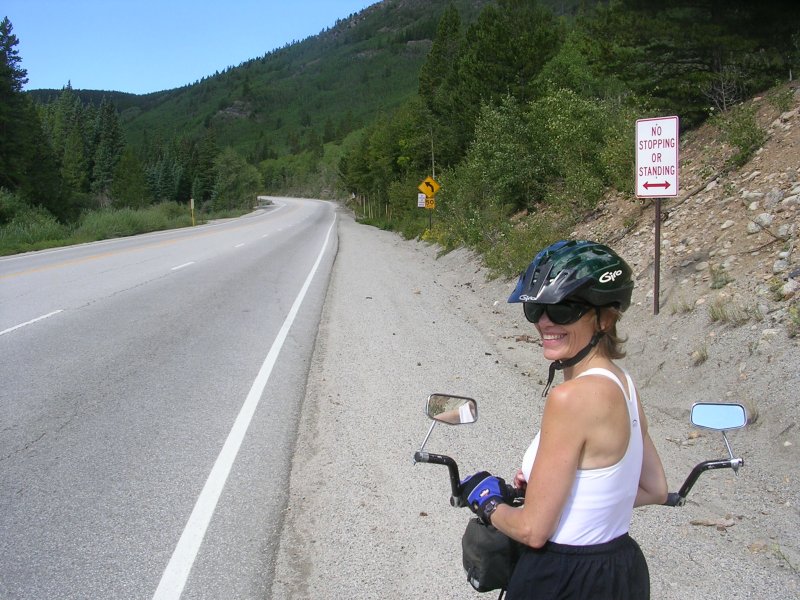 Bicycling Touring Tips, Lessons Learned,
and Tricks of the Trade
The Bicycling Touring Tips, Lessons Learned,
and Tricks of the Trade information became so large,
that we had to generate another web page.
About Bicycle Hire/Rental Issues
Long Distance Bicycle Hire/Rental Issues
The About Bicycle Hire/Rental Issues
discussion segment is now located with the
About Bicycle Touring web page.

See the following 'Interesting Bicycling Historical Facts'.
Useful Bike Organizations / Organisations:
Top- www.adventurecycling.org - Adventure Cycling (USA - Touring - We are Life Members)
- www.ctc.org.uk - Cyclists' Touring Club (CTC), since 1875 (UK's Largest Organisation)
- A List of USA Bicycle Clubs and some related bike forums, an excellent USA national list.
Interesting Bicycling Historical Facts
Top- When Touring (and not racing) Drove the Cycling World, Source: by Jan Heine, Adventure Cyclist, Jan, 2007:
- Susan B Anthony stated that "... Bicycling ... did more to emancipate women than anything else in the world". It allowed women to not have to wear dresses and it allowed women to check into a hotel without a man and bicycle tour groups facilitated men and women mixed (un-chaperoned) and some bicycle competitions had men and women competing with one another (not heard of, in recent history).
- Bicycles allowed the common working person to go on tour/holiday/vacation.
- Bicycle trip journaling affected the first Travel Articles to be written for tourism (both destination oriented and transportation-journey oriented).
- The first governmental offices of tourism were bike oriented and bike tour driven. The Touring Club de France was where tourists were initially referred when visiting France (regardless of their transportation method).
- Bicycles were once, generally, the fastest thing on the road.
- In the 1880's and 1890's, bicycle clubs caused road and byway improvements and the clubs had political clout.
- When Terry and I biked in Korea (1976), I was frequently told by Korean men, that they were surprised that a girl could ride a bike. We just always tried to set good examples. Sometimes they would share their picnic rice wines with us. Some women rubbed Terry's arm; we finally asked why; they wanted to know if we were really a different color underneath. We enjoyed Korean honesty and family respect.
- History of the Bicycle - Wikipedia
- History Timeline of the Bicycle
- Bicycle History
- blank


"Light, Strong, and Cheap. Pick Two." - Keith Bontrager, Bicycle Designer
Cool and Clever Bicycle Tour Conveniences
Top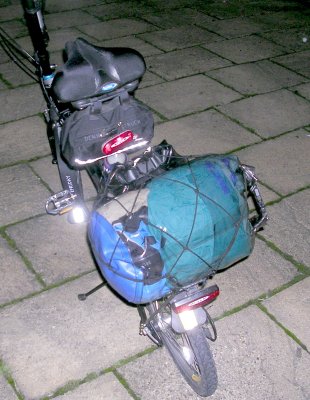
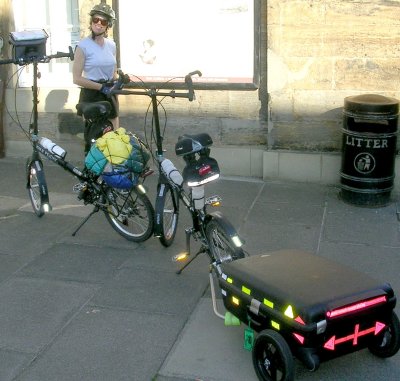
Bungee styled cargo net (left and right side pictures). Cargo nets are very utilizable for foreign travel and are worth having for any touring situation. An alternative to the cargo net is to have couple extra bungee cords per person (two 20-24 inch long are usually sufficient).
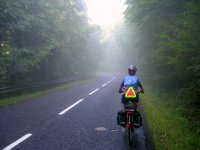
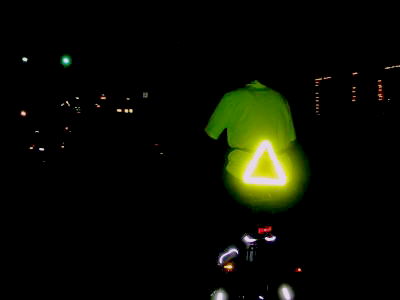 Safety reflective triangle (left and right side pictures). It may either be worn in a belt like fashion with the triangle to the rear OR the safety reflective triangle may be located on the back of rear rack mounted bags. We are convinced that our reflectors have already prevented accidents from happening. These items have a huge return for a cheap cost!
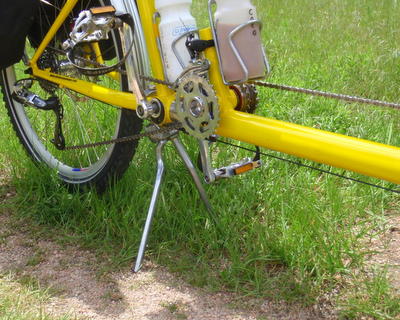 Basically, ALL single side kick stands don't work well (meaning that bikes fall a lot). The only bicycle kick stand that works properly is a bipod. There are two kinds of bipods, one is an "iron triangle" (they are too heavy and bulky, and sometimes even found on front wheels) and the other bipod has "two legs" (they are light and only recently available). Carl Mattson showed us and demonstrated an Esge/SKS Double Leg Kick stand on his tandem - we were amazed and ordered one that night on the Internet! Web search for Esge/SKS Double Leg Bicycle Kickstand (not cheap) - it is worth it! One of the neat things about a bipod is that one may easily perform some kinds of bike maintenance while on the road, so to speak.
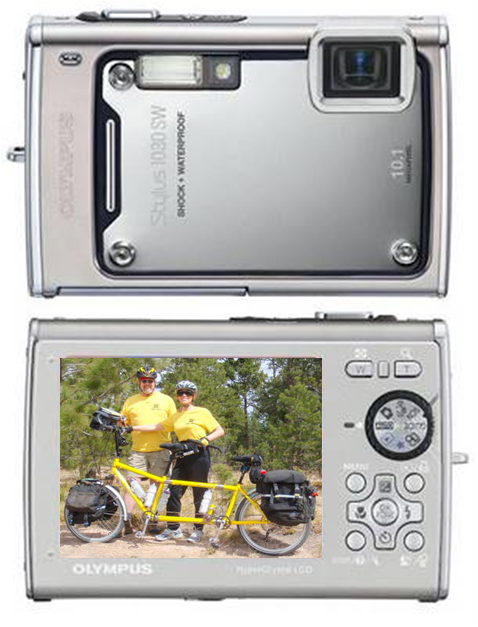 We only recommend stuff worth knowing about. Here's a case where our active lifestyle circumstance has resulted in nine cameras over a ten year period being broken. Six cameras were dropped (or thrown), one camera is at the bottom of Lake Taylor, one camera died after a river rafting trip, and another camera was sat upon. Now all of a sudden, we've had a camera that lasted two years - it's been for a swim, hit by a cue stick, dropped in a punch bowl, and dropped on the ground three times (so far). Once it fell off a fence post, set on timer, and that picture is to the readers left side. This miracle camera (miracle to us) is an Olympus Stylus 1030SW. It costs more than the average camera, but the second that it survives a spill, it just justified the higher price - our camera has saved us a several hundred dollars in new camera costs, so far. Oh yeah, this camera is shockproof (6.6ft), waterproof (33ft), freezeproof (14°f), and crushproof (220 lbf) - COOL Eh! 4x Optical. Addendum 1: The camera is NOT loss proof. We left one somewhere along the Arkansas River trail near Pueblo, Colorado. Put your name and telephone number on it! We're now on our second Oly 1030SW. Addendum 2: Olympus has ended the 1030SW line; some are still available via Amazon, Ebay, or such. I believe that the Olympus Stylus Tough 8010 Digital Camera is the replacement (now at 5x optical). Addendum 3: We did a 700+K Bike Tour in China, everyone was an experienced traveler, half of the cyclists had two cameras (always smart), and of the total of cameras 50% were a version of the Olympus Tough Stylus. I dropped my Stylus camera twice, once while pedaling; it still works.
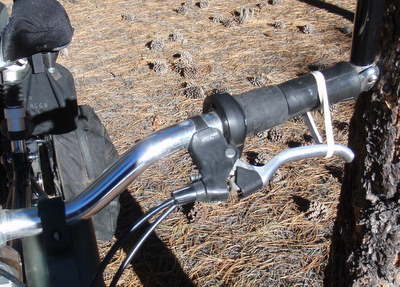
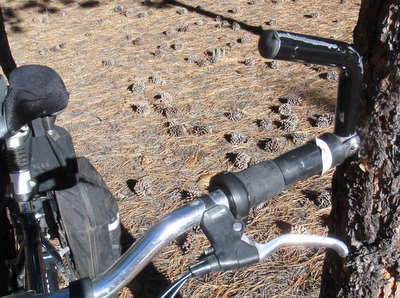 What does a bike do before it falls over? IT ROLLS!
An easy way to keep a bicycle from free rolling and falling over is to lock the front brake. This may be performed easily by strapping the front brake closed (simple rubber-band in picture). The full rest of the story and credits are shared at Parking Brake or Front Brake Lock Band/Strap/Wrap
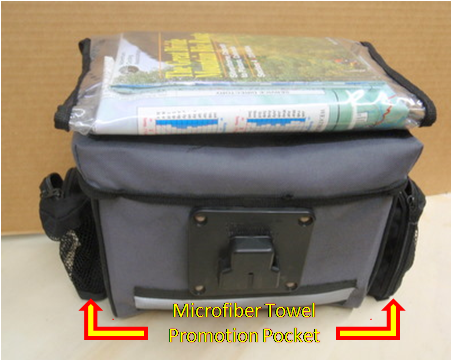 It was a nice old Handlebar Bag with the best map case/holder that I have ever had (velcro mounted and the map display case opens up, thus doubling the display area to read, a big deal on Adventure Cycling's Great Divide Maps). It didn't have any side pockets, so some pockets were added. We also added the reflector tape but that is a different story. We happened upon a sale of microfiber towels for a few dollars each. As part of the promotion, the towels were presented in nice little individual nylon netted zippered mini-sack. The sacks were immediately recognized as potential side-pockets to sew onto the handlebar bag. We used black rayon carpet thread and a curved needed. We made six attachment points, three forward and three rearward (high, middle, & low). The pockets work great for holding phones, little digital cameras, chapstick, and other small items that may be accessed rapidly. It is especially handy for quick camera access.
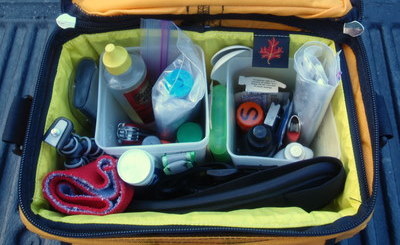 This is one of the better handlebar bags, for pockets, mounting, and space. The main storage area has no movable partitions for organizing the interior space, so we use plastic freezer boxes (quart size food storage containers). The convenience is that the freezer boxes help to keep things upright and readily accessible. We're not saying what to keep in a handlebar bag, but here is a peek at ours. The wallet, keys, pen and notepad, travel computer instructions and passport are kept in the top flap pocket (mostly out of view). Freezer Boxes (1 quart, tall) - Carolyn R.
 Gorillapod (one is sitting inside the preceding handlebar bag - view on the left inside). A Gorillapod is flexible tripod originally designed as a flexible, portable, packable camera tripod. We have used it for our Scotland to England Borders Picture (hooked to a fence post) and for our Great Divide Pictures (hooked to an aspen Tree Branch). Now Gorillapods are available with magnetic feet (to attach to cars, bikes, and other steel objects - see joby.com); they may hold some mobile devices (from phones to digital players), may work well as work as a camera tripod, and they work great for taking timer pictures that will actually have the camera operator and friend(s) in the same picture. It is probably just a matter of time before someone adds a receiving nut to a bike light.
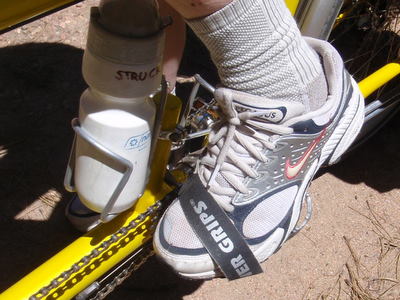 Power Grips are straps that go across the pedal and keep the foot on the pedal (no slippage) and Power Grips help to give lift to a pedal on the up motion of the pedal rotation (cycle). The importance and convenience of Power Grips is discussed in the About Tandems Section under the heading of Kicking the Captain Problem (in the About Bicycle Touring web page).
Warning: In soft sand/dirt areas and on cliff sides, ride the bike with the feet free; either place the feet on top of the power grips or on the other side of the pedals. We once had a zero speed fall where the bike just came to a stop in soft dirt (on a tandem) and the Copilot had a harder fall than the Captain because the Copilot's feet were stuck in the Power Grip - things just happened too quickly and 20/20 hindsight reminds us that we knew that we were in soft dirt country and we didn't think about freeing the feet from the pedals.
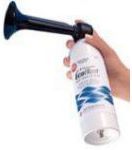 We met a tandem couple, the pilot Carl Mattson showed us two cool things about his bike, an Air Horn and a Two Leg Kickstand. They had a water bottle cage mounted under their front top tube that exists to hold an Air Horn. The air horn gives them the sound of a Mack Truck horn. Carl stated that it was a Great Dog Deterrent too, in fact he said that it has worked as a successful dog repellant in every case (I did not learn if he points the horn at the dog(s) or not). Another cool thing about the horn is that it is rechargeable through a Schrader air valve mounted on the bottom of the Air Bottle. It may be refilled with any bicycle pump or at a fuel station with an air hose. The horn is very effective on car and truck drivers. Eco friendly too (no yucky poly-carbons). There are different varieties and one of those varieties has a shorter horn (than pictured). Rechargeable Air Horns are available online and at Marine / Boat Supply stores.
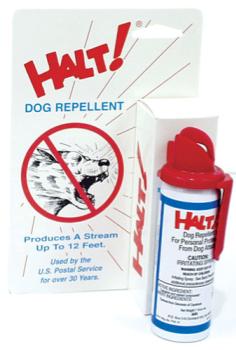 DOGs: This is a tender subject. Like most kids, Terry and I have grown up with dogs and other pets but we have each been bitten by a mean dog in separate circumstances. Without getting into animal or human psychology or physiology, it is just a fact that some dogs are just mean and they will bite. We, sometimes, carry a Capsaicin based Anti-Attack Dog-Spray approved for US Mail Carries (since 1966) called Halt.
"Who knows more about dog attacks than the mailman? Letter carriers have had to deal with aggressive dogs since Claudius Polonius was delivering rolls of parchment to citizens of the Roman Empire."
Website Quote - www.halt.com
Dennis did try Halt on himself, it was extremely unpleasant but he recovered, he doesn't want to demonstrate the process ever again and more importantly, and Dennis quit chasing bikes! Halt is available online (but not from the manufacturer) and it is also available at many Cycle Shops. It is possible that Halt may not be mailed outside the USA and that Capsaicin Sprays may not be legal in some countries outside the USA.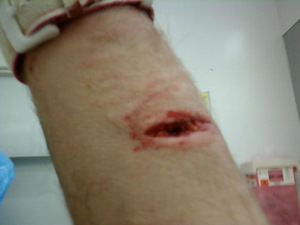 Right Side Image: Dog Bite on a joint use hike and bike trail; Barr Trail leads to Pikes Peak, on the west side of Colorado Springs (a very difficult ride or walk path BTW); Dug Johnson stated that in this case, having spray would not have mattered, this was a case of irresponsible handlers on a joint use trail.
This site's author wants to add that the dog that bit me was on a leash. On the other hand, of the few times that I have used dog spray, it was successful in stopping very aggressive dogs (close enough to spray in the face). In my cases (so far), the dogs' reaction to being sprayed was to calmly sit in place until the effects wore off.
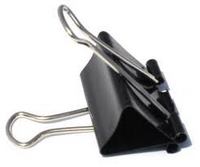
 A few Binder Clips and/or Clothes Pins may be very useful for a multitude of planned and unplanned tasks and functions. The binder clip is more useful in general and 4 or 5 of the small ones may serve a cyclist well. On occasion a medium or large binder clip may be more useful. Binder clips may rust after some time (faster on coast lines) and while the wood or plastic clothes pin won't rust, the metal pincher wire will. Do be careful because the metal clips will eventually rust, consider recycling these objects every other year. We keep some clips in our handle bar bag, often attached to the plastic separators (waiting to be used for something, most typically as a clothes pin). These items make a wonderful outback gift.
Following are some uses, geared more towards the Binder Clip: book marks, hold documents together or in order (good at check points, customs, and map briefings); clip cup (to hold personal or wash items like soap) to a rope, twig, or something; wire bundle or coil holder, hold a designated wired packet (AC, DC, USB, ear phone plugs), hose/tube (hold or pinch), toothpaste tube end/role pincher, hold object for sanitary boil (like hot pad mittens); holds shirt sleeve, bra strap (usually a safety pin is better), shirt gather, shirt clip; pen locator, large clips will hold objects in place on a table end, money clip (especially different denominations), hold sleeping bags together, clothing rips (duct tape too), key(s), recipe cards/notes, camp duties list, cuff link, tie holder, pen or pencil holder, keeps writing instruments from walking away, hold object together for gluing, pinch plastic food bag together, pinch rolled end of food sack closed, substitute game marker/piece, close an open tea bag/coffee bag, act as a loose leaf (note book) binder, loose pages binder, hold a makeshift envelope/holder together (to hold larger objects), hold something temporarily to a bicycle rack, hold a stick or wire onto a chain stay or seat stay so as to perform wheel truing in the field (need a large or extra large binder clip), hold multiple things as a separator on a cord, hold a trash bag open, hold a trash bag to a bench or table, keep something from rolling off a table.
by Breakaway Books, Halcottsville, New York, 2007 (4th Printing).